

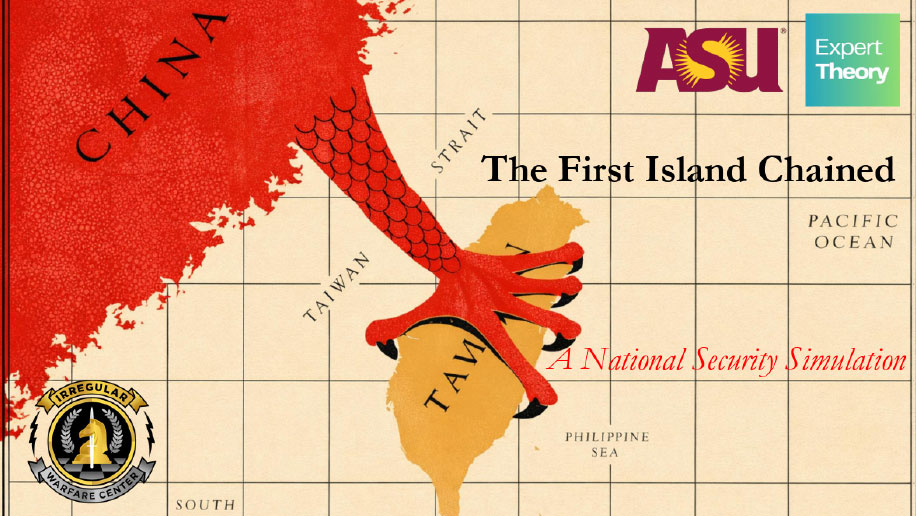
Doctors Lumpy Lumbaca and Sam Mullins from the Daniel K. Inouye Asia-Pacific Center for Security Studies (DKI APCSS) recently participated in “The First Island Chained: Taiwan Resistance and Resilience” wargame and workshop. Held at Northeastern University in Arlington from March 31 to April 2, 2026, the event represented a significant departure from traditional military simulations. Orchestrated by the Irregular Warfare Center (IWC) and Arizona State University (ASU), with technical execution from Expert Theory and supporting platforms like Providence, the exercise challenged participants to look beyond the kinetic “climax” of an invasion and instead grapple with the reality of a Taiwan occupation. Participants included a mix of seasoned irregular warfare practitioners, leading defense education institutions, and up-and-coming graduate students focused on national security. By shifting the focus toward resistance and subversion, the organizers created a space where legitimacy was as much a weapon as any missile system.
The wargame used an immersive, turn-based model to demonstrate how pre-invasion decisions fundamentally shape a society’s long-term resistance. Participants learned that actions taken in the “gray zone” were not merely preparatory but determinative. As the scenario progressed, it became clear that a society’s ability to resist is largely decided before the first boots hit the ground. The game revealed that if domestic preparation and international legitimacy are neglected during peacetime, they cannot be easily improvised under the pressure of occupation.
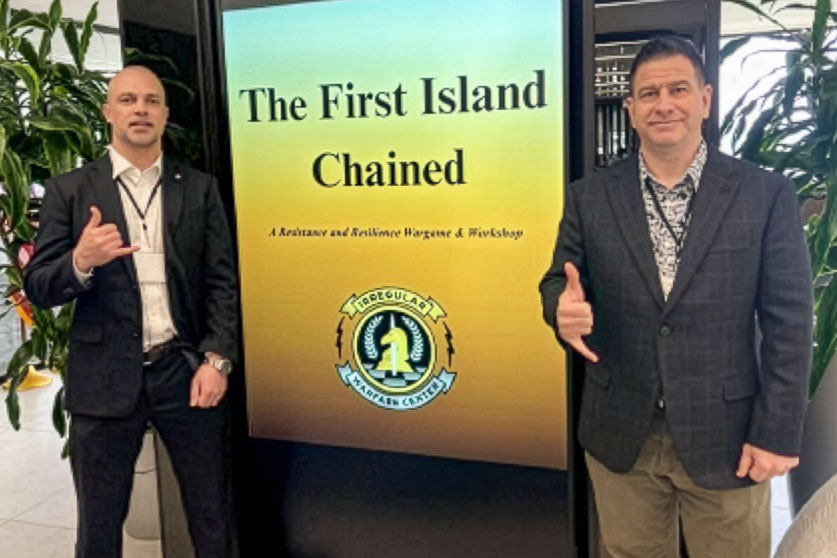
Dr. Sam Mullins (left) and Dr. Lumpy Lumbaca (right) at the Workshop
Participant actions throughout the simulation directly influenced the evolving information and political environments. When the scenario turned kinetic, allied responses were often slowed by diverging national timelines and successful Chinese pre-positioning. The loss of major allied assets underscored the high cost of delayed coordination. These operational setbacks forced participants to pivot from active defense to supporting a fractured, multi-layered resistance divided into kinetic, non-kinetic, and political arms. This systemic approach to resistance was a key lesson: to be effective, underground movements must connect tactical violence with broad public mobilization and a coherent claim to legitimacy.
In addition to the execution of the wargame, First Island Chained included a number of Subject-Matter Expert panels throughout the week. In one of the panels, Dr. Lumpy Lumbaca from DKI APCSS provided insights into the differences between developing resistance capabilities and structures before occupation versus executing resistance activities after invasion. A key lesson learned was that if resistance is carefully planned and organized before hostilities break out, it may deter invasion altogether. Overall, the exercise emphasized that for an occupier, military success is only a means to the end of consolidating long-term control. Just because China puts boots on the ground does not mean it will be able to establish legitimacy or maintain domestic and international support in the face of a persistent resistance movement. For Taiwan and its allies, the lesson was one of endurance and strategic foresight. Resistance is a whole-of-society phenomenon that succeeds not just through combat, but by refusing to allow the occupier to convert battlefield control into durable political and informational dominance.
The Irregular Warfare Center (IWC) LinkedIn post, including story and photos




Leave A Comment