

Lapse In Appropriations

The most recent appropriations for the Department of War have expired. Military personnel will continue in a normal duty status, without pay, until such time as a continuing resolution or appropriations are passed by Congress and signed into law. Civilian personnel not engaged in excepted activities will be placed in a non-work, non-pay status.

May 24, 2011

News

Transnational Security Course 25-2 – Mutual Understanding is Critical

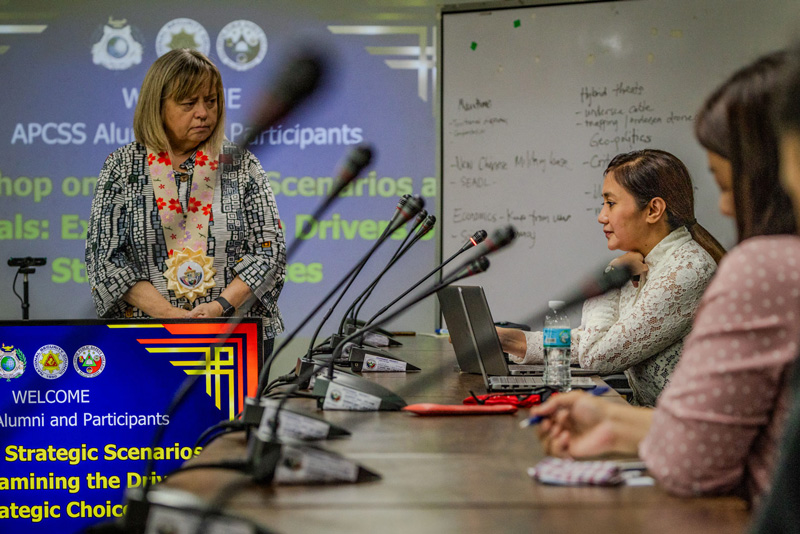
In early December, the final Transnational Security Course (TSC 25-2) of 2025 was held in Maluhia Hall on the campus of the Daniel K. Inouye Asia Pacific Center for Security Studies (DKI APCSS) in Waikiki, attracting 40 senior security practitioners from 24 countries and reuniting eight alumni with the Center. The course was an intensive, six-day program for current sector leaders, both civilian and military, on the upward track for positions of significant national and international responsibility.

By |2025-12-18T14:15:13-10:00December 18, 2025|Categories: Courses, news|Tags: , , , , |

Strategic Voices Episode 1 – India’s Grand Vision: Can Strategy Match Ambition?

India’s strategic autonomy has long been a source of national pride and a flexible diplomatic instrument. In an earlier era, it allowed New Delhi to preserve freedom of action while engaging multiple power centers. Today, however, the same posture is being reinterpreted. In a more competitive and increasingly transactional global environment, partners are looking less for declarations of independence and more for dependable alignment in moments that matter.

By |2025-12-19T15:17:50-10:00December 18, 2025|Categories: news, Podcast|Tags: , , , |

Inaugural JPME2 Indo-Pacific Orientation Course Concludes, Cultivating New Regional Experts

The Daniel K. Inouye Asia-Pacific Center for Security Studies (DKI APCSS) successfully hosted the first-ever JPME2 Indo-Pacific Orientation Course (JIPOC 25-1), a 13-week, specially designed executive education program that concluded in December 2025. This landmark effort, a collaboration between DKI APCSS, the National Defense University (NDU), and U.S. Indo-Pacific Command (USINDOPACOM), enhanced the capabilities of U.S. security practitioners focused on the Indo-Pacific region.

By |2025-12-17T16:50:46-10:00December 17, 2025|Categories: Courses, news|Tags: , , , |

DKI APCSS Celebrates 30 Years of Indo-Pacific Security

Gathering regional leaders, alumni, foundation members and distinguished guests, DKI APCSS celebrated its 30th Anniversary Alumni Workshop on Sept. 17, 2025, with a commemorative dinner honoring three decades of collaboration across the Indo-Pacific.

Enhancing Decision-Making with AI: Start Human, End Human

A new Security Nexus Perspective by Dr. Elizabeth Vaughan Moyer examines the strategic application of large language models in Indo-Pacific security operations while addressing technology competition and sovereignty concerns. Moyer, a DKI APCSS fellow and major in the U.S. Air Force, tackles the urgent challenge facing security professionals: leveraging artificial intelligence for enhanced decision-making without compromising critical thinking or accountability. The analysis emphasizes a key argument: organizations that embrace experimentation with imperfect technology will gain significant advantages over those waiting for ideal solutions.

Craig Painter

Lt. Col. Craig Painter joined the Daniel K. Inouye Asia-Pacific Center for Security Studies as an Army Fellow in August 2025. He holds a Bachelor of Science in Public Relations from Illinois State University and a Master of Arts in Management from the American Military University. His military education includes the Command and General Staff Officer College, Combined Logistics Captain's Career Course, and the Military Intelligence Basic Officer Leaders Course.

By |2026-01-20T10:44:18-10:00December 12, 2025|Categories: Faculty, Biography, team|

Security Nexus Perspective: Small States and the Geopolitical Chessboard in the Indo-Pacific

A new Security Nexus Perspective by Dr. Andrea Malji, a professor at the Daniel K. Inouye Asia-Pacific Center for Security Studies, examines the strategic role of small states in the Indo-Pacific and their growing influence in global geopolitics. Malji highlights how nations such as Kiribati, the Solomon Islands, Maldives, and Dominica, despite their small populations, occupy critical positions in the contest for global influence. Their decisions on diplomatic recognition, infrastructure partnerships, and alignment with major powers carry significant weight in shaping the regional balance of power. The analysis underscores a key argument: geopolitical competition in the Indo-Pacific is not limited to major capitals but is equally shaped by the choices of small states navigating external pressures and domestic challenges.

Security Nexus Perspective: Critical Minerals and Coercive Power in the Indo-Pacific

Andrea Malji, a professor at the Daniel K. Inouye Asia-Pacific Center for Security Studies, examines the strategic role of critical minerals in the Indo-Pacific and their use as tools of geopolitical leverage. Malji highlights how rare earth elements and their derivatives are essential for advanced technologies, with the Indo-Pacific serving as the hub for processing and transport. China’s dominance in refining capacity and control over key maritime chokepoints has enabled it to use mineral policy as a form of statecraft, influencing global supply chains and state behavior.

Go to Top