
Abstract
While the immense potential for biotechnologies (biotech) to benefit humankind are broadly recognized, the geopolitical threats to US security from its explosive advances are under-appreciated. The security community must recognize the urgent need for strengthening, streamlining, and synergizing US, allies’, and partners’ biotech enterprises to deter China’s recent, rapid ascension across a wide range of biotech fields that present enormous challenges to our nation’s economic, health, and other security facets. Simultaneously, security practitioners among allies and partners should quickly develop enhanced coordination mechanisms to predict, detect, and respond effectively to biotech-based threats, whether from lone-wolf bio-terrorists, quasi-natural mutation and migration of viral, bacterial, and/or fungal strains, and/or human-generated accidental or purposeful release of harmful biological and/or biochemical agents.
Key words: bioweapons, economics, biological warfare, geopolitics
Introduction: Breadth of Biotech’s Impacts on Economic and Health Security
Biotechnology-based approaches and methods drive advances in an ever-expanding array of fields, including healthcare, agriculture, environmental sciences, industrial processes, and warfare (see Figure 1). These range from traditional and widely recognized processes such as fermentation in bread and beer-making, to more recent developments such as genetic modification of crop plants, bio-remediation of polluted biomes, medical uses of CRISPR-Cas9 therapies, biofuels, and DNA ‘fingerprinting.’ The global biotech market value is expected to increased from about $1.77 T in 2025 to $6.34 T in 2035, that is, more than tripling over the upcoming decade.[i]
Figure 1 shows a sampling of some of the major applications of biotech across multiple disciplines and sectors; the listings are by no means comprehensive nor inclusive. Both the US and the PRC, as well as a number of other nations, have major industrial endeavors advancing in many of these areas; many of these endeavors are linked together through a web of supply chains, with both states holding advantages in certain key areas.
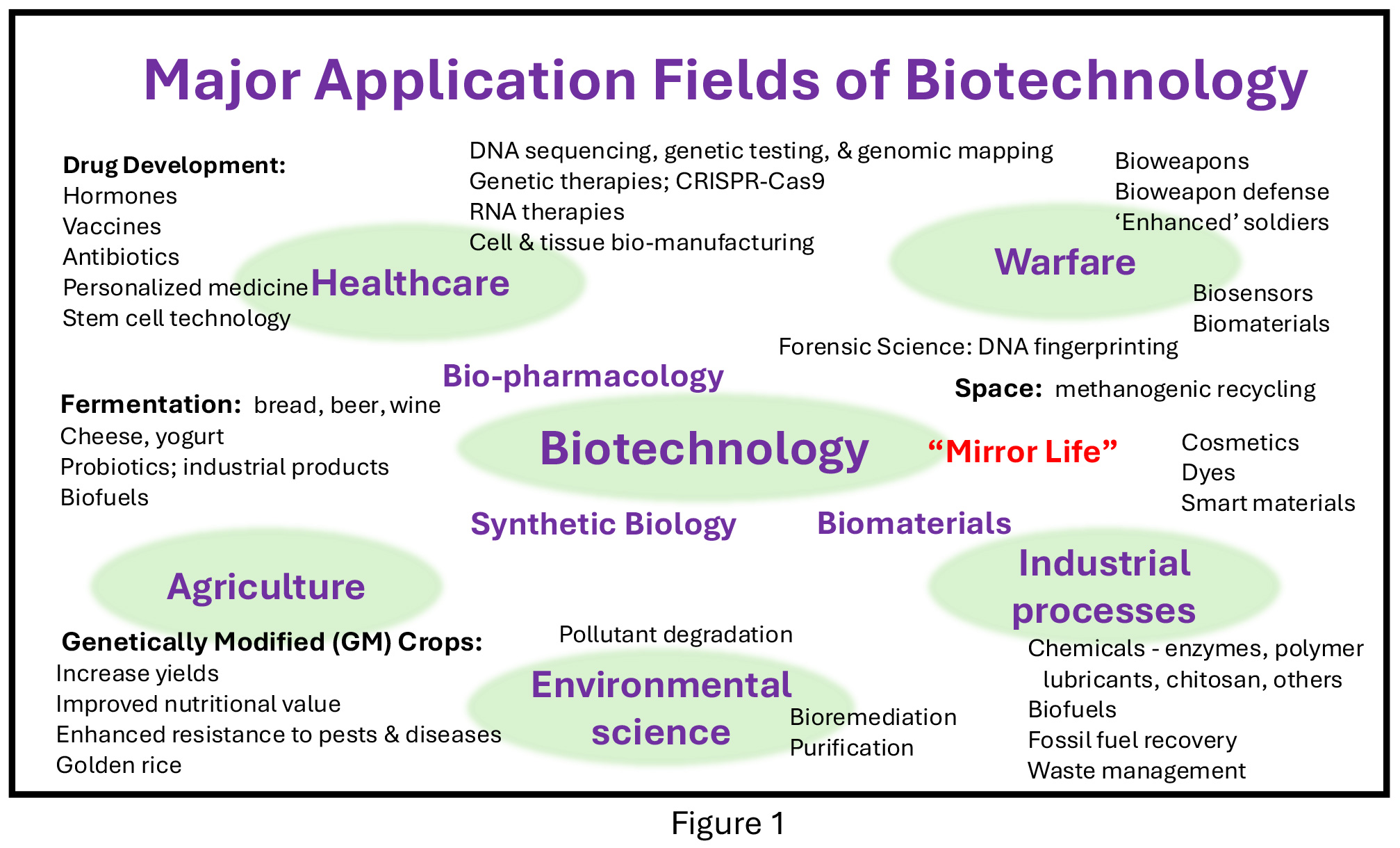
Beyond many familiar fields, Figure 1 includes facets of biotech that are less widely understood or appreciated. For example, the concept of synthetic biology – the creation of novel biological organisms, systems, or processes through genetic engineering techniques – is emerging as a new and extraordinarily powerful biotech approach with applications across a myriad of biotech fields, including bio-warfare and bio-defense. And the idea of mirror life – creation of synthetic forms of life composed of mirror-image molecules (opposite chirality) compared to all known life on Earth – illustrates a biotech frontier that many scientists are cautious about even exploring due to its potential to create organisms that could be entirely resistant to natural biodegradation and undetectable by existing immune systems, and thus could present a literally existential threat to all existing life on earth.[ii]
Duality of Biotech Threats to National Security
Biotech in various forms has been used historically in warfare, but the threat of its spread and potential for the user’s own assets, as well as those of the user’s adversaries, has limited its application in war.[iii] Emerging technologies, however, significantly expand the threat base for both large-scale, state-sponsored warfare and ‘lone wolf’ bioterror attacks.[iv] In addition, the continual expansion of human-animal interfaces – via human incursion into previously uninhabited biomes, needs/desires for animal protein in our diets, globalized rapid transportation, etc. – provide every-increasing opportunities for novel zoonoses (animal to human transmission of pathogens) to arise and spread in human populations.
Many new biotech ‘cookbooks’ and off-the-shelf technologies that are appearing almost daily offer significant threats, now and in the near future, in that they enable more precise control of processes to create bioweapons. It may be, for example, soon feasible to create a pathogen that is particularly virulent against some ethnic groups based on their genomic make-up; or, vice versa, a pathogen that is relatively incapable of attacking persons with the genomic make-up of the creator’s own ethnic group.
Moreover, due to the proliferation of techniques and technologies, and their widespread dissemination on the internet, such bioweapons increasingly may be created by individuals and small-scale operations with limited funds and little scientific expertise. This capability, particularly in combination with the specificity noted in the prior paragraph, makes bio-terror attacks feasible. In this sense, biotech represents a danger of equal magnitude but with a much larger potential instigator population than do nuclear weapons.[v]
Beyond the concept of bioweapons, however, the concept that ‘economic security is national security’ is highly and broadly relevant to biotech. Given the broad and exploding applications of biotech across virtually the entire spectrum of human enterprises – cf., Figure 1 – the economics of biotech represent an immediate, significant national security challenge.[vi] The US has long enjoyed global leadership in this arena, but is being increasingly challenges, especially by the PRC.
Rapid Rise of China as a Biotech Super-Power
Over the past 50 years, the PRC has moved swiftly, consistently, and coherently to build a strong, well-aligned biotechnology enterprise. As part of a broad expansion of Chinese university programs designed to advance many aspects of science, technology, engineering, and mathematics (STEM), China established the China National Center for Biotechnology Development (CNCBD) in November 1983 to coordinate national biotechnology programs.[vii] This was followed by the landmark “863 Program” in March 1986, a major state initiative to accelerate STEM development, which designated biotechnology as one of eight key fields for R&D to narrow the gap with the West.[viii]
However, biotech development efforts were not confined to government-run programs. In 1999, the Beijing Genomics Institute (BGI) was founded as a non-governmental research center to represent China in the international Human Genome Project. This marked the beginning of what would become a global genomics powerhouse, initially focused on large-scale sequencing projects.[ix] And in 2000, WuXi PharmaTech (now WuXi AppTec) was founded by Dr. Ge Li in Shanghai. Starting as a small chemistry services lab, it has since grown into a massive global contract research, development, and manufacturing organization (CRDMO) that is integral to the global pharmaceutical supply chain.[x]
These private endeavors soon began to pay off. BGI successfully sequenced the rice genome in 2002, a significant scientific achievement that was featured as a cover story in the journal Science, and demonstrated China’s rapidly growing capabilities in large-scale genome sequencing.[xi] Not sitting on its laurels, BGI purchased 128 advanced Illumina HiSeq 2000 gene-sequencing machines in 2010, backed by a $1.5 B loan from the state-owned China Development Bank. This acquisition instantly created one of the world’s largest and most powerful sequencing factories, signaling a strategic state-backed push for dominance in genomics.[xii] As part of a multi-faceted, long-term strategy to obtain and build off of foreign technology, in 2013, BGI acquired the US-based Complete Genomics, a major supplier of DNA sequencing technology. This move allowed BGI to internalize cutting-edge sequencing technology and eventually develop its own proprietary platforms, such as MGI’s DNBSEQ, reducing its reliance on foreign suppliers.[xiii]
During this period, the Chinese government continued to move forward in promoting biotech. As part of its “Made in China 2025” plan, in 2015 it officially listed biotechnology as one of ten critical high-tech sectors for development. The goal was to transform China into a global leader in high-tech manufacturing, with targets for increasing the domestic market share of Chinese-made core components and materials to 70% by 2025.[xiv] This initiative has driven massive investment and policy support into the biotech industry.[xv]
A pivotal moment came in 2016, when scientists in China were the first in the world to use the revolutionary CRISPR gene-editing technology in a human patient, as part of a clinical trial for aggressive lung cancer. This milestone highlighted the country’s ambition and more permissive regulatory environment for pushing the boundaries of genetic medicine.[xvi] Two years later, China’s National Medical Products Administration (NMPA) implemented a new policy reducing the clinical trial review and approval waiting period to just 60 working days, down from many months or even years. This reform dramatically accelerated the drug development process, making China one of the fastest and most cost-effective places in the world to run clinical trials, which further boosted its biotech sector.[xvii]
The PRC also has made biotechnology a key priority under its Military-Civil Fusion (MCF) strategy, which aims to eliminate barriers between the civilian and defense sectors. PLA scientists and strategists have identified biology as critical for future military advantage, funding research into areas like human performance enhancement, biomimetic systems, and brain science. This includes exploring controversial technologies like “specific ethnic genetic attacks” and “brain control” weaponry, indicating a deep interest in the dual-use and national security applications of biotechnology.[xviii] The US State Department has formally requested studies on the implications of this strategy for international biosecurity.[xix]
Through this broad spectrum of governmental, private, and military developments, the PRC today is recognized as a global leader in biotech around the world. Chinese companies have become highly competitive internationally, with a significant presence in global biotech supply chains as noted above, with WuXi AppTec a leading global service provider and BGI a worldwide presence with its sequencing services and technologies.[xx]
To sum up, China’s coherent industrial policies over the past decades have effectlvely positioned the country as a leading global competitor in biotechnology.[xxi] The PRC has expanded its biotech efforts beyond specific sectors to a “whole-of-nation” effort aimed at technological self-reliance and comprehensive industrial strength through:
- State-Directed Investment and Support: China utilizes massive industrial support, including subsidies, tax breaks, and government-directed venture capital funds, to give its companies a competitive edge. This has resulted in a 400-fold increase in biopharma R&D spending over the past decade.
- Military-Civil Fusion (MCF): Beijing’s MCF strategy, working with the PLA, is developing dual-use technologies with potential military applications.[xxii]
- Regulatory Reforms: China has streamlined its clinical trial and drug approval processes, transforming what was once a slow system into one of the world’s fastest. This has enabled Chinese biopharmaceutical companies to conduct faster and cheaper clinical trials, giving them a strategic advantage.
- Global Expansion and Technology Acquisition: Chinese companies are aggressively acquiring foreign technology and intellectual property through licensing deals, acquisitions, and illicit means. Entities like BGI Group and WuXi AppTec have become deeply embedded in global supply chains, creating critical dependencies for the United States.
Security Implications of Falling Behind in Biotech
This PRC strategy of steady, whole-of-society, cohesive biotech development is quite different from the entrepreneurial, market-driven, regulatory-burdened biotech developmental process that has characterized US advances in biotech in recent decades.
Reflecting its individualistic and even fragmented perspective, over recent decades, the US government has funded a decreasing proportion of research and development (R & D), including the field of biotechnology – from about 1% of its GDP in 1990 to about 0.6% today. In contrast, since 2000, the PRC has increased its governmental support of R & D from 0.3% to 0.45% of its GDP. In terms of actual monetary investment, the nations are more similar; the US spends ~$900 B per year now, while the PRC spends ~$800 B per year. The two countries far outspend any others, with the E.U. being a distant third at ~$550 B.[xxiii]
Beyond direct government support, however, many private firms are heavily invested in US biotech, creating an overall economic impact of > $3.2 T in 2023 (the most recent year for which such data is available.[xxiv] And biotech is growing rapidly, having experienced a 15% expansion in employment between 2019 and 2023. Taken as a whole, the industry employs over 2 M Americans and constitutes about 5% of the US GDP. The US held about a 60% share of the global biotech sector in 2021. From these figures, it is clear that failing to continue to build the biotech enterprise, and to keep pace with the PRC, would have significant negative impacts on the US economy and, ultimately, its security.[xxv]
Deterrence Mechanisms: Empowering the US biotech enterprise
Given the ever-increasing impacts of biotech on multiple aspects of everything from individuals’ lives to national security, the opposing government spending trends in PRC vs. US biotech activity have alarmed many US analysts. Effectively deterring the PRC from dominating the global biotechnology industries will require a major shift – many would say a revolution – in comprehensive and multi-faceted US strategies that addresses economic competitiveness, national security, and technological innovation; a robust American strategy should be built on the pillars of bolstering domestic capabilities, securing the bioeconomy, strengthening national security, and leveraging international partnerships.
To counter China’s ambitions, the US ought to consider how best to adopt a proactive and coordinated strategy that strengthens its own biotechnology ecosystem while mitigating the risks posed by the PRC.[xxvi] The National Security Commission on Emerging Biotechnology (NSCEB) Final Report: “Charting the Future of Biotechnology” delivered to Congress in 2025 outlines recommendations to accelerate US biotechnology innovation and biomanufacturing to reinforce the bioeconomy as a pillar of national security and economic competitiveness, noting that a primary focus of the US strategy must be to out-innovate the competition.[xxvii]; [xxviii] Its key recommendations include:
- Increase Research and Development (R&D) Funding: A significant increase in federal R&D spending is crucial. A congressional commission has recommended a minimum of $15 B over the next five years to unleash private capital and accelerate innovation.
- Bridge the “Valley of Death:” The US needs to create new financing mechanisms, such as the proposed “Independence Investment Fund,” to provide strategic investments for promising early-stage technologies that struggle to find capital. This would help de-risk innovation and counter adversarial foreign investment.
- Build Domestic Biomanufacturing Capacity: The US currently lacks sufficient biomanufacturing infrastructure, making it reliant on foreign capacity. Congress should authorize and fund the development of a network of pre-commercial bioindustrial and biopharmaceutical manufacturing facilities across the country.
- Modernize the Regulatory Framework: To accelerate the path from lab to market, the US should simplify and streamline its regulatory processes for biotechnology products.
A vital feature of this innovation is to secure the US bioeconomy by protecting American intellectual property, data, and supply chains from exploitation, with recommendations including:[xxix]; [xxx]
- Strengthen Investment Screening and Export Controls: The Committee on Foreign Investment in the United States (CFIUS) should be strengthened to better scrutinize and block predatory Chinese investments in the US biotech industry. Additionally, the US should implement stronger controls on outbound investments to prevent American capital from funding Chinese companies that threaten national security.
- Protect Against Intellectual Property Theft: The US should take a more aggressive stance against China’s legal and illicit acquisition of American intellectual property. This includes enhanced enforcement and penalties for IP theft.
- Secure and Onshore Supply Chains: The US is dangerously reliant on China for active pharmaceutical ingredients (APIs) and other critical components. Legislation like the BIOSECURE Act aims to prevent US taxpayer dollars from flowing to “foreign adversary biotech companies” and to encourage the onshoring of manufacturing.[xxxi];[xxxii]
- Treat Biological Data as a Strategic Asset: The US needs a national strategy to collect, standardize, and secure biological data, treating it as a strategic resource for innovation while blocking China from obtaining sensitive US biological data.
Equally, the US might well consider how best to protect its biotech advantages as a critical part of strengthening national security and biodefense. The dual-use nature of biotechnology necessitates a strong focus on the national security implications of China’s advancements, including:
- Counter Military-Civil Fusion: An increase in intelligence focused on China’s military-related life sciences R&D and prevention of diversion of dual-use technologies to the PLA.
- Address Weaponization and Ethical Concerns: China’s interest in “specific ethnic genetic attacks” and “brain control” weapons highlights the serious risks of their biotech programs and mandates the need for US preparation to defend against these and other novel biological threats.
- Promote Biosecurity and Transparency: Increased pressure on China from the US and allies to be more transparent about its life sciences research and to comply fully with the Biological Weapons Convention (BWC).
As noted in the last of the above bullets, in addition to the above steps, as the US cannot act alone in this competition; a robust thrust of leveraging alliances and partnerships is critical:
- Coordinate with Allies: Working with like-minded countries on research, talent development, and commercialization to harness the collective strengths of democratic nations.
- Build Resilient International Supply Chains: Establishing biomanufacturing alliances and data-sharing agreements with allies and partners to create more resilient and secure global supply chains, reducing dependence on China.
China’s rapid rise in the biotechnology sector is not just an economic challenge but a significant national security threat. While the US still possesses considerable strengths in innovation, its lead is eroding. A successful deterrence strategy will require a sustained, whole-of-government effort that prioritizes investment in domestic capabilities, protects the US bioeconomy, confronts the national security risks, and strengthens alliances. The window for action is closing, and the United States must move with urgency and strategic focus to secure its leadership in the biotechnology revolution.
Detection Mechanisms: Identifying biotech-based threats
The US has in place a number of agencies, organizations, and mechanisms dedicated to detecting and defending against biological and/or biotech threats, including the National Biodefense Strategy and Implementation Plan for Countering Biological Threats, Enhancing Pandemic Preparedness, and Achieving Global Health Security. [xxxiii] This document lays out – five main goals: enabling risk awareness, preventing bioincidents, ensuring preparedness, responding rapidly, and facilitating recovery. [xxxiv] One key agency is the National Science Advisory Board for Biosecurity (NSABB).[xxxv] The NSABB provides technical advice, guidance, or recommendations to relevant Federal departments and agencies related to biosafety and biosecurity oversight of biomedical research; in 2023 it produced a Proposed Biosecurity Oversight Framework for the Future of Science that enumerates 12 key findings and 12 key recommendations (half with multiple sub-recommendations) for building a more cohesive, coordinated, and responsive US biosecurity administration.[xxxvi]
As the initial responders to a bioterrorist event are often from the public health and medical communities, a key part of the US detection strategy is to rapidly detect unusual disease patterns through various surveillance methods. These initial responders work within a larger public health and laboratory-based surveillance network of local, state, federal, military, and international laboratories to respond to biological and chemical threats.[xxxvii] As a part of this network effort, intelligence gathering agencies monitor individuals and groups for signs of radicalization or attempts to weaponize biological agents. [xxxviii] China, for instance, has been identified as using cyber operations and disinformation campaigns to undermine the US public health response during the COVID-19 pandemic, highlighting the need to monitor such activities.[xxxix]
Multiple types of surveillance are used in the detection of biological and/or biotech threats, including:
Public Health Surveillance: The continuous, systematic collection, analysis, and interpretation of health-related data.
Syndromic Surveillance: This method monitors data that precedes a formal diagnosis, such as school absenteeism, emergency call volumes, and over-the-counter drug sales, to spot unusual spikes in activity that could indicate an outbreak.
Digital Surveillance: In recent years, digital tools have become a key part of surveillance. This includes monitoring social media platforms like Twitter, internet search trends on Google for flu-related or other symptom-based searches, and crowdsourced data from sites where users report symptoms. These methods can often detect outbreaks 1-2 weeks ahead of traditional reporting systems.
Laboratory-Based Surveillance: This involves the analysis of data from clinical laboratories to identify unusual clusters or patterns of disease. The CDC’s Laboratory Response Network (LRN; see below) is a key part of this, ensuring that labs can rapidly diagnose and characterize biological agents.[xl]
Intelligence Gathering: Intelligence agencies play a critical role in monitoring individuals and groups who may be planning attacks. This includes tracking online activity, communications on encrypted apps and the dark web, and looking for indicators of radicalization or weaponization of biological agents. This is particularly challenging with lone actors who do not operate within a larger organizational structure.
While, for security reasons, the following list may not be comprehensive, it includes the key public-facing components of the US biodefense infrastructure. These organizations are involved in a broad spectrum of research, surveillance, and response to biological threats.[xli]; [xlii]
Department of Homeland Security (DHS): The DHS Science and Technology Directorate oversees two main laboratories focused on national security, the National Biodefense Analysis and Countermeasures Center (NBACC)[xliii] and the Plum Island Animal Disease Center (PIADC).[xliv]
Department of War (DoW): DoW’s main facility that researches and develops medical countermeasures to biological threats is the US Army Medical Research Institute of Infectious Diseases (USAMRIID).[xlv]
Department of Health and Human Services (HHS): Two HHS agencies play a crucial role in public health preparedness and response to biological threats, the Centers for Disease Control and Prevention (CDC)[xlvi] and the Laboratory Response Network (LRN).[xlvii] The LRN is designed to provide rapid laboratory response to inform critical public health decisions. The LRN consists of sentinel, reference, and national labs. Sentinel labs, often in hospitals, are the front line, tasked with recognizing and ruling out potential biothreats before referring them to higher-level reference labs, such as those at state health departments. National laboratories, like those at the CDC and the US Army Medical Research Institute of Infectious Diseases (USAMRIID), provide specialized testing and definitive characterization of agents.
US Department of Agriculture (USDA): The USDA’s Animal and Plant Health Inspection Service (APHIS) is responsible for protecting animal and plant health via its Animal and Plant Health Inspection Service (APHIS).[xlviii]
While detection of biotech threats is obviously critical, preemption is equally so, focusing on preventing malicious actors from acquiring the materials and knowledge needed to carry out an attack. Many of the same organizations, agencies, and mechanisms listed above for Detection are also involved in deterrence. Major thrusts of deterrence endeavors include:
- Controlling Access to Pathogens and Toxins: The US government regulates the possession, use, and transfer of certain biological agents and toxins that pose a severe threat to public health and safety through the Federal Select Agent Program (FSAP).[xlix] The FSAP, jointly managed by the CDC and USDA, regulates the possession, use, and transfer of biological agents and toxins that pose a severe threat to health. This program was strengthened after the 2001 anthrax attacks and includes a subset of “Tier 1” agents that are considered the highest risk and are subject to stricter security controls. Laboratories working with these agents must be registered, and personnel must undergo a Security Risk Assessment by the FBI.
- DNA Synthesis Screening: A critical chokepoint in the creation of a bioweapon is the synthesis of DNA. The US government has been working to implement policies that require providers of synthetic DNA to screen orders for sequences of concern that could be used to create dangerous pathogens.
- International Cooperation: Bioterrorism is a global threat, and international collaboration is essential. This includes sharing surveillance data, best practices, and coordinating response efforts through organizations like the World Health Organization (WHO) and via international legal frameworks, such as the Biological Weapons Convention.
Response Mechanisms
As part of the US system of biotech threat detection and deterrence, response mechanisms – in the event of a biotech attack or incident occurring – are also in place.[l];[li] A strong and flexible public health infrastructure is the best defense against any disease outbreak, whether natural or intentional. Key components of this preparedness include:
- The National Pharmaceutical Stockpile (NPS): A national repository of life-saving pharmaceuticals, vaccines, and medical supplies that can be deployed within hours to the site of a biological event.[lii]
- Research and Development: The US invests heavily in research to develop new vaccines, drugs, and diagnostic tools to counter bioterrorism threats. This is a collaborative effort between agencies like the National Institutes of Health (NIH), the DOW, and the CDC.[liii]
- Interagency Coordination: A coordinated response across all levels of government is critical.[liv] This involves collaboration between the Department of Homeland Security (DHS), the Department of Health and Human Services (HHS), the DoW, the Department of Agriculture (USDA), the Environmental Protection Agency (EPA), and law enforcement agencies like the FBI. The recently mandated National Biodefense Strategy aims to improve this interagency coordination.
Discussion
From the preceding, it is clear that the US and PRC approaches to biotechnology reflect differing cultures of the administration of the countries’ scientific enterprises.[lv] The former is driven largely by the interests and motivations of individual and small groups of scientists, with some limited governmental guidance or encouragement in terms of grants and funding programs. While regulations and elements of a national biotech defense strategy are in place, overall coordination and synergy of actions are weak. The latter is a long-term government initiated, directed, and sustained strategic approach to advance national interests, as perceived by the Chinese Communist Party (CCP). The CCP has prioritized biotech for many years, and controls and coordinates R & D efforts closely.
The history of the United States makes it clear that its approach to the larger scientific enterprise – i.e., driven largely by scientists – has been massively successful. For much of the 20th century the US was widely and rightfully viewed as a major, if not the primary, source of scientific and technological innovation. However, as detailed in the source cited at the start of this Discussion section, the PRC has, through its focused, strategic, government-driven approach, made tremendous and incredibly rapid strides in the scientific and technological realms, and now matches or even exceeds the US as a leader in various fields.
The extraordinary ‘dual use’ nature of biotechnology – with its unrivaled and multi-faceted potential to improve the global human position along with its literally existential threat to destroy humanity – bring the strengths and weaknesses of these two disparate scientific governance systems to the forefront. In straightforward economic terms, competition between the US and PRC in biotech has already radically shifted the balance of power, with the latter rising from a non-entity 50 years ago to a near-equal, if not superior, competitor today. With advances in biotech ever more deeply shaping increasing facets of the lives of ever-larger numbers of people on the planet, how will this economic competitiveness play out? Considered as potential weaponry, what does the explosive growth of the PRC biotech portend?
In addressing both of these questions, a key consideration is if or how the multi-layered but fragmented US system of biotech deterrence can constrain the hurtling juggernaut of PRC biotech development. Without overall synergy, can the various independent, widespread, and not-well-interconnected US agencies, organizations, and programs serve as an effective shield against either natural or human-generated biological threats? While many aspects of the US detection and response mechanisms are undoubtedly excellent programs, the diverse biotech fields are advancing so rapidly, on so many fronts, that a stronger, much better integrated network, better prepared to perceive and quickly and efficiently respond to emerging threats – economic, health, and otherwise – is urgently needed.
Conclusions
To effectively deter China and address the biotechnology threats from natural and non-state actors across the broad spectrum of economic, health, and other facets of national security, a number of key US agencies and reports – including the National Security Commission on Emerging Biotechnology final report, “Charting the Future of Biotechnology;” the National Biodefense Strategy and Implementation Plan for Countering Biological Threats, Enhancing Pandemic Preparedness, and Achieving Global Health Security; and the National Science Advisory Board for Biosecurity – jointly recommend that the diverse cadre of US biotechnological leadership inaugurate and implement a more proactive and more strongly coordinated strategy. A key aspect of this deterrence will be keeping a strong focus on the national security implications of China’s advancements, including countering its military-civil fusion, addressing weaponization and ethical concerns while promoting biosecurity and transparency, is critical. Simultaneously, a more aggressive stance against China’s acquisition of American biotech intellectual property – strengthening investment screening and export controls, securing and onshoring supply chains, and treating biological data as a strategic asset – will be required. Finally, these groups and reports recommend that the US biotech sector work more closely together with its allies and partners to upgrade private capital and accelerate innovation by: (a) ensuring that significantly increased federal biotech research and development funding is allocated over the next several years; (b) inaugurating new financing mechanisms to nurture promising early-stage technologies; (c) building domestic biomanufacturing, bioindustrial, and biopharmaceutical manufacturing capacity; and (d) modernizing and streamlining regulatory frameworks.
[i] – https://www.precedenceresearch.com/biotechnology-market
[ii] – https://www.pasteur.fr/en/research-journal/news/mirror-life-inside-discussion
[iii] – https://pmc.ncbi.nlm.nih.gov/articles/PMC1200679/#:~:text=pathogens%20(2).-,World%20War%20I,followed%20(10%2C%2011).
[iv] – https://pmc.ncbi.nlm.nih.gov/articles/PMC1200679/
[v] – https://dkiapcss.edu/nexus_articles/biotechnology-great-power-competition-and-security-an-overview/
[vi] – https://dkiapcss.edu/nexus_articles/biotechnology-great-power-competition-and-security-an-overview/
[vii] – https://en.wikipedia.org/wiki/Biotechnology_industry_in_China
[viii] – http://en.chinaculture.org/focus/2009-09/03/content_347003.htm
[ix] – https://en.wikipedia.org/wiki/BGI_Group
[x] – https://www.wuxiapptec.com/about/history
[xi] – https://en.wikipedia.org/wiki/BGI_Group
[xii] – https://www.govinfo.gov/content/pkg/GPO-CRPT-105hrpt851/html/ch1bod.html
[xiii] – https://global-mgitech.com/
[xiv] – https://merics.org/en/report/made-china-2025
[xv] – https://multimedia.scmp.com/news/china/article/2167415/china-2025-biotech/index.html
[xvi] – https://multimedia.scmp.com/news/china/article/2167415/china-2025-biotech/index.html
[xvii] – https://www.fiercebiotech.com/biotech/accelerate-drug-development-china-proposes-shorten-clinical-trial-review-time
[xviii] – https://ndupress.ndu.edu/Portals/68/Documents/prism/prism_8-3/prism_8-3_Kania_82-101.pdf
[xix] – https://www.state.gov/wp-content/uploads/2024/03/ISAB-TOR-Biotechnology-in-the-PRCs-Military-Civil-Fusion-Strategy_final_Accessible-03.20.2024.pdf
[xx] – https://services.bgi.com/bgi-genomics-global-genomics-services-bgi).
[xxi] – https://merics.org/en/comment/made-china-2025-successful-enough-make-industrial-policy-sequel-credible
[xxii] – https://www.state.gov/wp-content/uploads/2024/03/ISAB-TOR-Biotechnology-in-the-PRCs-Military-Civil-Fusion-Strategy_final_Accessible-03.20.2024.pdf
[xxiii] – https://www.nature.com/articles/d41586-024-03403-4
[xxiv] – https://www.bio.org/press-release/new-report-finds-bioscience-sector-generates-over-3-trillion-us-economy
[xxv] – https://bio.widen.net/s/hflmb92hwx/the-us-bioscience-economy-driving-economic-growth-and-opportunities-in-states-and-regions
[xxvi] – https://www.wttlonline.com/stories/isab-releases-key-studies-on-PRC-strategy-disarmament-and-us-security-cooperation,13118
[xxvii] – https://fas.org/publication/charting-the-future-of-biotechnology/
[xxviii] – https://ndupress.ndu.edu/Portals/68/Documents/prism/prism_8-3/prism_8-3_Kania_82-101.pdf
[xxix] – https://www.aspistrategist.org.au/facing-china-on-two-fronts-the-us-needs-strategic-focus/
[xxx] – https://osp.od.nih.gov/wp-content/uploads/2023/03/NSABB-Final-Report-Proposed-Biosecurity-Oversight-Framework-for-the-Future-of-Science.pdf
[xxxi] – https://www.klgates.com/BIOSECURE-Act-What-You-Need-to-Know-1-20-2026
[xxxii] – https://www.chemistryworld.com/news/us-government-moves-to-block-chinese-biotechs-operations/4019194.article
[xxxiii] – https://nphl.org/index.cfm/laboratory-response-network/
[xxxiv] – https://bidenwhitehouse.archives.gov/wp-content/uploads/2022/10/National-Biodefense-Strategy-and-Implementation-Plan-Final.pdf
[xxxv] – https://osp.od.nih.gov/policies/national-science-advisory-board-for-biosecurity-nsabb/
[xxxvi] – https://osp.od.nih.gov/wp-content/uploads/2023/03/NSABB-Final-Report-Proposed-Biosecurity-Oversight-Framework-for-the-Future-of-Science.pdf
[xxxvii] – https://globalbiodefense.com/tag/select-agents/
[xxxviii] – https://www.governance.ai/research-paper/dual-use-ai-capabilities-and-the-risk-of-bioterrorism-converting-capability-evaluations-to-risk-assessments
[xxxix] – https://aspr.hhs.gov/biodefense/Pages/goals.aspx
[xl] – https://en.wikipedia.org/wiki/Laboratory_Response_Network
[xli] – https://en.wikipedia.org/wiki/National_Biodefense_Strategy
[xlii] – https://en.wikipedia.org/wiki/United_States_biological_defense_program
[xliii] – https://www.dhs.gov/science-and-technology/national-biodefense-analysis-and-countermeasures-center
[xliv] – https://www.dhs.gov/science-and-technology/plum-island-animal-disease-center
[xlv] – https://usamriid.health.mil/
[xlvii] – https://www.cdc.gov/laboratory-response-network/
[xlviii] – https://www.aphis.usda.gov/
[xlix] – https://ehs.umich.edu/wp-content/uploads/2019/05/6_Federal-Select-Agents-Program-and-Import-Permits.pdf
[l] – https://www.cdc.gov/readiness/media/pdfs/PHEPSupplementalGuidance_LRNC_FINAL_3119.pdf
[li] – https://aspr.hhs.gov/biodefense/Pages/default.aspx
[lii] – https://remm.hhs.gov/sns.htm#:~:text=top%20of%20page-,Where%20are%20the%20SNS%20assets%20stored?,that%20overwhelms%20locally%20available%20resources
[liii] – https://pmc.ncbi.nlm.nih.gov/articles/PMC12848792/#:~:text=In%20the%20US%2C%20key%20partners%20include%20the%20National%20Institutes%20of%20Health%20(NIH)&text=Department%20of%20Defense%20(DoD)%2C%20as%20well%20as%20private%20diagnostic%20test
[liv] – https://www.synbiobeta.com/read/the-influence-of-synthetic-biology-on-national-bioeconomy-strategies
[lv] – https://dkiapcss.edu/nexus_articles/biotechnology-great-power-competition-and-security-an-overview/
Published: June 1, 2026
Category: Perspectives
Volume: 27 - 2026
Author: Ethan Allen