

Honolulu—December 17, 2025
India’s strategic autonomy has long been a source of national pride and a flexible diplomatic instrument. In an earlier era, it allowed New Delhi to preserve freedom of action while engaging multiple power centers. Today, however, the same posture is being reinterpreted. In a more competitive and increasingly transactional global environment, partners are looking less for declarations of independence and more for dependable alignment in moments that matter.
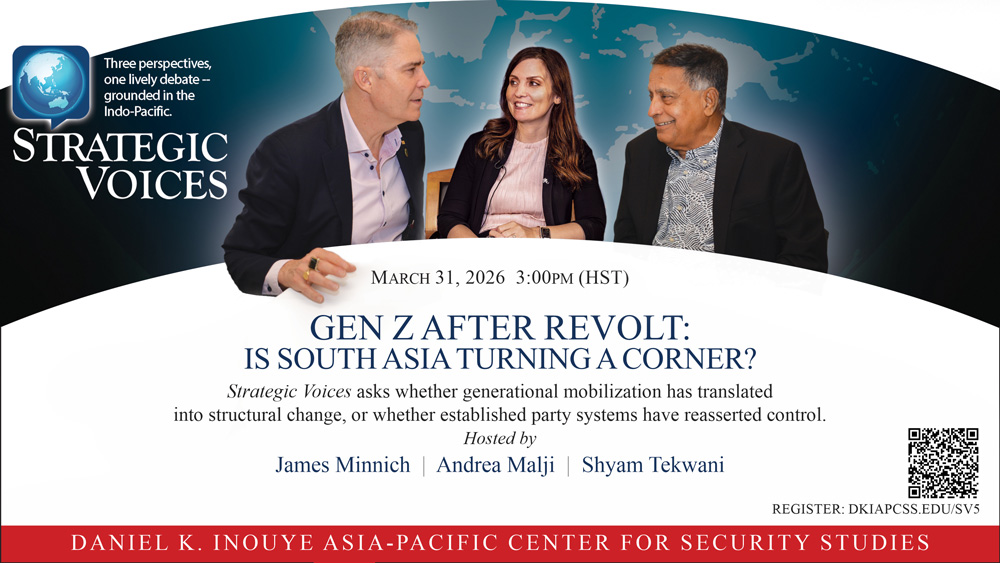
In the debut episode of Strategic Voices, Professors James Minnich, Shyam Tekwani, and Lami Kim examined whether India’s strategic autonomy continues to deliver influence—or whether it is increasingly read as aloofness, carrying tangible downstream costs.
Predictability: The New Strategic Currency
Professor Tekwani argued that the sharpening of geopolitical competition has made calibrated ambiguity harder to sustain. “Ambiguity is no longer cost-free,” he observed, noting that the central concern among partners is not India’s refusal to enter formal alliances, but uncertainty about how India will act when stakes rise.
In practice, predictability has become a form of strategic currency—particularly in domains such as intelligence cooperation, technology sharing, and operational coordination, where trust is built through repeated, reciprocal actions. As Tekwani aptly put it: “Partners don’t ask India to choose sides; they ask it to show up. Predictably.”
The Friction of Aloofness
Dr. Minnich underscored the specific risks of an autonomy that begins to read as detachment. When a state is perceived as noncommittal, it risks losing relevance in rapidly evolving decision-making cycles. Minnich outlined four concrete “friction points” that can emerge when partners perceive aloofness:
- Slower Access: Being bypassed in early-stage diplomatic consultations.
- Delayed Intelligence: Receiving actionable information later than closer partners.
- Deprioritization: Falling lower on a partner’s list when political capital is scarce.
- Reduced Influence: Losing the opportunity to shape planning rather than merely respond to outcomes.
These are not rhetorical penalties. They represent real losses of leverage in day-to-day statecraft. The implication is not that India must abandon autonomy, but that it may need to clarify its purpose: is autonomy meant primarily to maximize flexibility, or to maximize influence in ways that partners can recognize and reward?
Defining the Benchmark of Success
Dr. Kim offered an essential counterbalance, cautioning against underestimating India’s achievements. Pointing to India’s imminent rise as the world’s third-largest economy, its nuclear deterrent, and its expanding military capabilities, she noted, “We should give India more credit.”
At the same time, Kim highlighted the challenge of relative power. As long as a significant gap persists between India and China, New Delhi may feel it has not yet truly “arrived.” That perception shapes India’s tolerance for risk and helps explain why strategic autonomy remains attractive—even as it generates friction with key partners.
Strategy or Drift
In closing, Tekwani drew a sharp distinction between deliberate strategy and unintentional drift. “No country can become a great power while fighting itself internally,” he warned. More pointedly, he added, “Hedging your most important partnerships isn’t strategy; it’s drift. History rewards those who align ambition with capacity—and punishes those who don’t.”
The discussion converged on a clear conclusion. Strategic autonomy remains a viable path for India—but only if it is continuously recalibrated. To translate ambition into durable influence, India must signal to partners that when it counts most, it will not only be autonomous—it will be present.
Referenced in this Episode:
- Bajpaee, C. (2025). India’s Strategic Autonomy Is Now Reading as Aloof. Foreign Policy.
- Mohan, C. R. (2025). India and the Rebalancing of Asia. Foreign Policy.
- Bal, H. S. (2025). The Staying Power of India’s Hindu Right. Foreign Affairs.
- Rahman, M. (2025). The Folly of India’s Illiberal Hegemony. Foreign Affairs.
- Tekwani, S. & Sampath, S. (2025) India’s Strategic Ascent and South Asia’s Strategic Edge. In Edge of Competition (Ed. J. M. Minnich).




Leave A Comment