

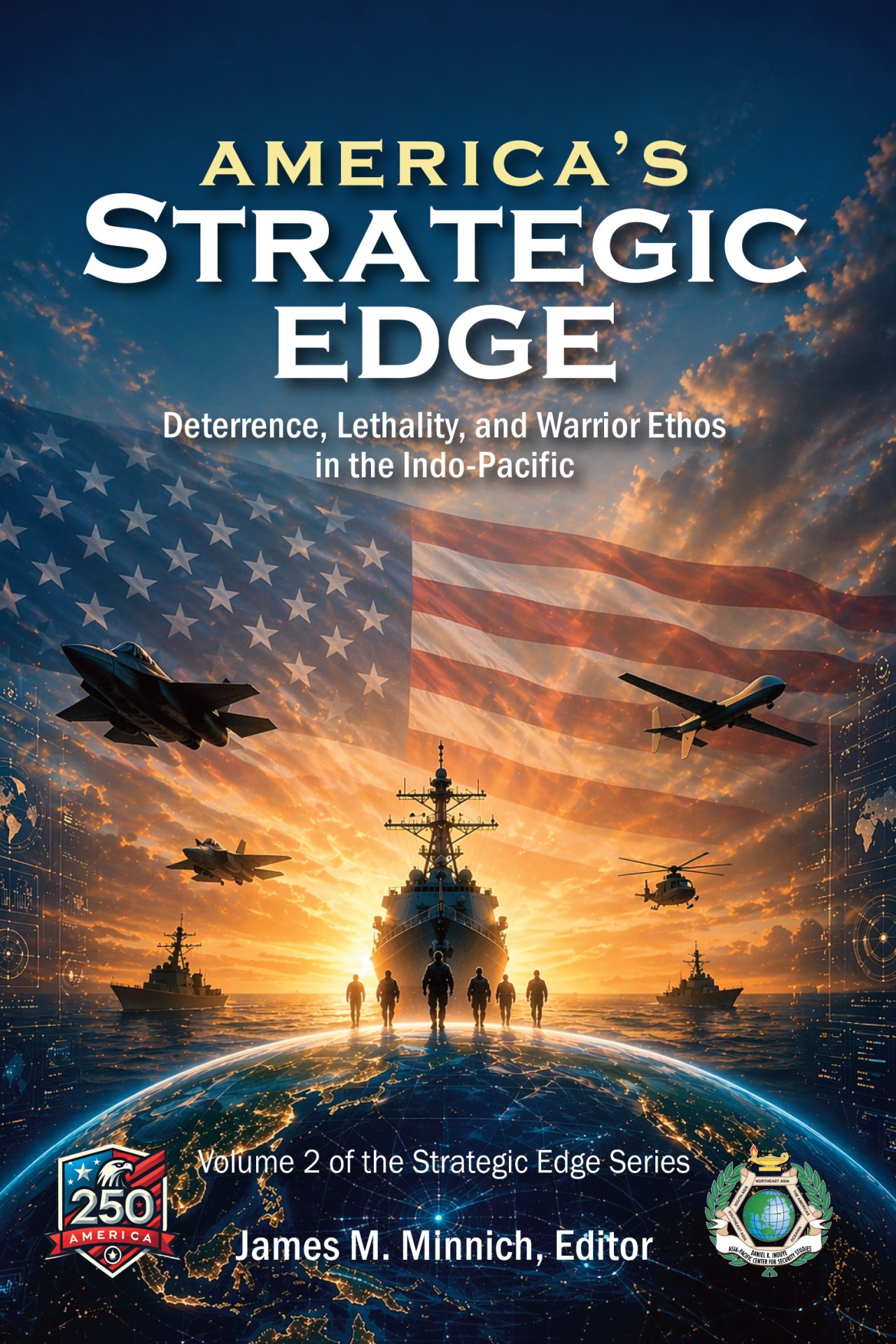
Book Title
America's Strategic Edge
Deterrence, Lethality, and Warrior Ethos in the Indo-Pacific
Editor
Dr. James M. Minnich
ISBN
979-8-9992930-1-5
Disclaimer: The authors are solely responsible for the views expressed in this publication. These views do not necessarily represent the official policy or position of the DKI APCSS, the U.S. DOW, or the U.S. Government. Furthermore, any reference to specific commercial products, processes, or services by trade name, trademark, manufacturer, or otherwise does not constitute or imply their endorsement, recommendation, or favoring by DKI APCSS, DOD, or the USG.
Abstract
America's Strategic Edge: Deterrence, Lethality, and Warrior Ethos in the Indo-Pacific, the second volume in the Strategic Edge series, arrives at a pivotal moment as the United States approaches its 250th anniversary. This collection examines the three interconnected pillars essential to preserving stability in the world's most consequential region: deterrence creates the space for peace, lethality ensures deterrence remains credible, and the warrior ethos provides the moral foundation that governs the use of power. Bringing together a diverse group of scholars and practitioners, the volume explores how these elements sustain America's strategic advantage amid rapid military modernization, contested domains, and intensifying competition across the Indo-Pacific. Grounded in the conviction that lasting security is built through relationships, the book offers strategic clarity and professional insight for leaders entrusted with defending the region's future.
Foreword
Author: Maj Gen (Ret.) Suzanne “Suzy” Vares-Lum View Foreword
Preface
Author: Dr. James M. Minnich View Preface
Chapter 1: The Edge that Endures
Author: Dr. James M. Minnich
Abstract: America’s strategic edge has endured not through geography or abundance alone, but through outward engagement, industrial strength, and the integration of deterrence, lethality, and warrior ethos. In an era of competitive multipolarity, sustaining that edge will require strategic discipline, resilient alliances and industrial networks, acquisition agility, and the ability to adapt faster than adversaries in a contested Indo-Pacific.
DOI: https://doi.org/10.71236/rfevpzz7
Chapter 2: Deterrence Under Pressure
Author: Dr. Andrea Malji
Abstract: Deterrence has emerged as the organizing principle of U.S. statecraft in a competitive multipolar Indo-Pacific, shaping how the United States prevents coercion, manages escalation, and sustains regional stability. Effective deterrence, the chapter argues, depends on the integration of credible capability, strategic communication, resilient partnerships, disciplined escalation management, and continuous adaptation across military and nonmilitary domains.
DOI: https://doi.org/10.71236/332rtc8e
Chapter 3: Architecture of Advantage
Author: Shyam Tekwani and Saumya Sampath
Abstract: Deterrence in the Indo-Pacific must be deliberately constructed through an architecture of denial that integrates military power, alliance networks, force posture, and statecraft into a coherent system. Sustained advantage, the chapter argues, depends not on declaratory policy alone, but on the structured integration of conventional and nuclear forces, cyber and space resilience, distributed basing, resilient logistics, and coordinated diplomatic, economic, and technological power across domains and geography.
DOI: https://doi.org/10.71236/6xptf6g2
Chapter 4: Deterring Gray-Zone Warfare
Author: Dr. Sam Mullins
Abstract: Gray-zone warfare has become a central feature of strategic competition in the Indo-Pacific, enabling adversaries to erode deterrence through coercive actions below the threshold of armed conflict. The chapter argues that restoring deterrence requires clear differentiation between actions that can be deterred and those that must be managed, combined with stronger whole-of-government coordination, allied integration, calibrated risk acceptance, targeted costs for perpetrators, and resilience that complements credible punishment and denial.
DOI: https://doi.org/10.71236/jphdcd10
Chapter 5: Holding the Line at Sea
Author: Shyam Tekwani and Saumya Sampath Abstract: Maritime deterrence in the Indo-Pacific must move beyond episodic demonstrations of force toward a continuous, networked architecture of presence anchored in law, alliances, and forward posture. The chapter demonstrates how the United States and its partners can integrate naval power, coast guard legitimacy, island-chain geography, multilateral cooperation, and resilience across cyber and economic domains to deter coercion at sea without escalating the region toward crisis.
DOI: https://doi.org/10.71236/6ew4404j
Chapter 6: Stability at the Nuclear Edge
Author: Dr. Bill Wieninger and Dr. Andrea Malji
Abstract: Strategic stability in the Indo-Pacific depends not on numerical parity or arms racing, but on reinforcing deterrence through survivable capability, disciplined communication, and credible commitment. Adapting the enduring logic of Cold War deterrence to a more complex nuclear landscape, the chapter argues that the United States can sustain extended deterrence for allies, reduce the risk of miscalculation, and preserve stability at the nuclear edge in an era of competitive multipolarity.
DOI: https://doi.org/10.71236/kvgqcn30
Chapter 7: Economic Pressure, Industrial Resilience, and Deterrence
Author: Dr. Tim Buehrer and Dr. Lori Forman
Abstract: Economic power, industrial policy, and capital allocation are no longer peripheral to national security but central instruments of deterrence in an era of sustained competition. The chapter demonstrates how coordinated economic statecraft, resilient industrial readiness, public–private collaboration, and allied economic partnerships strengthen defense preparedness, blunt coercion, and reinforce America’s strategic advantage.
DOI: https://doi.org/10.71236/fd2ksypz
Chapter 8: Siezing the Orbital High Ground
Author: Dr. Namrata Goswami Abstract: Space superiority has become indispensable to sustaining U.S. lethality and deterrence in an era of competitive multipolarity. The chapter examines how the United States, China, and Russia conceptualize and contest the orbital domain, highlighting the technologies, vulnerabilities, and resilient architectures that will determine who commands the ultimate high ground in the Indo-Pacific.
DOI: https://doi.org/10.71236/fd2ksypz
Chapter 9: Multi-Domain Operations in System-Centric Warfare
Author: Dr. Lami Kim
Abstract: Multi-Domain Operations (MDO) are emerging as the U.S. military’s answer to China’s system-centric approach to warfare, which seeks to disrupt and paralyze the connective architecture of joint operations. The chapter argues that deterrence in the Indo-Pacific will depend less on platform dominance than on the ability to integrate forces, fuse information, and sustain resilient, allied-enabled command and control through CJADC2 across contested multi-domain environments.
DOI: https://doi.org/10.71236/d9h03gyw
Chapter 10: Algorithmic Speed and the Future of Lethality
Author: Dr. Virginia Bacay Watson
Abstract: Artificial intelligence is reshaping military command, decision-making, and the ethical foundations of warfare through increasingly complex human–machine interactions. The chapter argues that while AI can accelerate information processing and operational effectiveness, overreliance on algorithmic systems risks eroding human judgment, accountability, and moral responsibility in the use of force.
DOI: https://doi.org/10.71236/npfss9qe
Chapter 11: Allied Shipyards, American Strength
Author: Dr. Srini Sitaraman
Abstract: Maritime deterrence in the Indo-Pacific depends not only on fleet size, but on the industrial system capable of sustaining, repairing, and regenerating combat power at speed. The chapter demonstrates how aligning allied shipbuilding capacity with American standards, modernizing domestic infrastructure, and integrating distributed sustainment hubs across trusted partners can transform industrial resilience into operational availability—and availability into strategic advantage.
DOI: https://doi.org/10.71236/6nreh48c
Chapter 12: Lead at the Edgy
Author: Colonel (Ret.) James M. Minnich and SEAC David L. Isom
Abstract: Leadership remains the decisive asymmetric advantage in an era where success depends not only on technology and firepower, but on the ability to integrate Ethos, Adaptability, Connection, and Decision into disciplined action at the edge. Through the E-A-C-D framework, the chapter demonstrates how strategic leaders build resilient teams, align alliances, empower decentralized execution, and sustain moral clarity under the pressures of all-domain warfare.
DOI: https://doi.org/10.71236/j38vzahv
Chapter 13: Warrior Traditions, Modern Strength
Author: Dr. Lumpy Lumbaca Abstract: Warrior traditions across the Indo-Pacific remain living sources of cohesion, professionalism, and operational effectiveness, shaping how militaries train, lead, and cooperate in coalition environments. By examining martial legacies from Oceania to Northeast and Southeast Asia—and linking them to the American tradition of disciplined initiative and decentralized command—the chapter demonstrates how shared warrior values strengthen interoperability, trust, and coalition resilience in an era of distributed operations and strategic competition.
DOI: doi.org/10.71236/hq4tmhs4
Chapter 14: Warrior Ethos is Hybrid War
Author: Dr. Elizabeth Kunce and Chris Jackson
Abstract: In an era of hybrid warfare and machine-speed decision cycles, the decisive advantage lies not only in technology or lethality, but in the cognitive, moral, and psychological endurance of the force. The chapter argues that resilience, post-traumatic growth, and fortitude are essential components of the warrior ethos, sustaining the ethical clarity, disciplined judgment, and purposeful persistence necessary for deterrence, readiness, and long-term strategic legitimacy.
DOI: https://doi.org/10.71236/k6xqwmpc
Chapter 15: Organizing Power
Author: Dr. Elizabeth Kunce and Dr. Elsa B. Kania
Abstract: Resilience in the twenty-first century depends less on raw technological superiority than on a nation’s ability to organize power coherently, legitimately, and at speed across government, the military, industry, and society under sustained pressure. Through a comparative analysis of democratic resilience and China’s military-civil fusion model, the chapter argues that the United States must strengthen whole-of-society coordination and public-private integration to preserve legitimacy, maintain escalation control, and sustain strategic advantage during prolonged competition.
DOI: https://doi.org/10.71236/fkvwjr8e
Chapter 16: Responsibility in Machine-Age Warfare
Author: Dr. Lukas Filler
Abstract: The central ethical risk of military AI is not machine autonomy but human abdication: the tendency to treat algorithmic speed, confidence scores, and procedural validation as insulation from responsibility in war. Examining autonomy, remote warfare, cyber operations, and biotechnology, the chapter argues that preserving the warrior ethos in machine-age warfare requires leaders to retain the burden of command while building accountability, epistemic competence, and structural safeguards that keep responsibility inseparable from authority.
DOI: https://doi.org/10.71236/g14xbakm
Afterword by Dr. James M. Minnich


