

Fellow Project is an integral part of DKI APCSS’s long courses. It requires participants to undertake a project demonstrating their expertise by applying their acquired knowledge and skills. This process includes:
- Collaboration and Networking: Fellows work together and engage with faculty and experts, fostering relationships and mutual understanding.
- Perspective Sharing: Discussing local, national, and regional security challenges enhances networks and deepens understanding of a rules-based order and a free and open Indo-Pacific region.
- Research and Analysis: Fellows leverage their experience to research a specific topic, increasing situational awareness, creating viable options, and forming practical recommendations through critical thinking.
- Expand capacity for critical thinking
- Practice querying, dialogue, cooperation, and connecting with key stakeholders
- Hone inquiry skills for future work
- Produce outcomes of real-world value
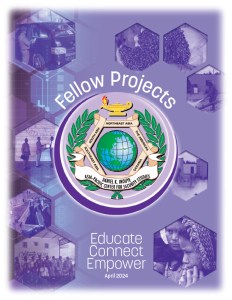
Read the latest fellow’s project booklet to celebrate their achievements and discover how their work fosters a secure and prosperous region.
- Individual Fellow Project: Each fellow undertakes a project focusing on a specific challenge related to a policy, program, process, or practice. This project is completed independently, allowing the fellow to apply their unique insights and expertise.
- Cohort Project (Group Project): In this format, fellows collaborate on a group project. To participate in a Cohort Project, each fellow must be preselected by their respective country’s embassy and DKI APCSS. This collaborative approach encourages teamwork and leverages the diverse perspectives of the fellows involved.
* If your country wishes to send a team to work on a Cohort Project, inform the US Embassy, the DKI APCSS Recruiter (recruiter@apcss.org), and the Fellow Project Team (fellowsproject@dkiapcss.net).
Fellow Project Highlight
Project Phases
| Fellows Project | Cohort Projects | |
|---|---|---|
| Before Course |
|
|
| During Course |
|
|
| After Course |
|
|
Latest News and Guest Speakers

DKI-APCSS learning model proven once again, this time in first-ever Mobile-APOC held outside the U. S.
The Daniel K. Inouye Asia-Pacific Center for Security Studies (DKI APCSS) co-sponsored a first-ever four day Mobile Asia-Pacific Orientation Course (MAPOC) held outside U. S. borders Sept. 12-15 in Seoul. The course was co-sponsored by [...]
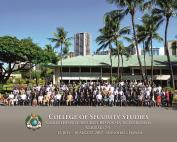
101 Fellows Tackle Security Challenges as CSRT 17-1 Concludes
One hundred one Fellows from 47 different locations graduated Aug. 10 from the Asia-Pacific Center for Security Studies’ Comprehensive Security Responses to Terrorism (CSRT) course in Honolulu. Of the 101 participants, 63% were from [...]
148 Fellows Gain an Expanded Understanding of Regional Issues in APOC 17-2
One hundred and forty-eight U.S. and international Fellows completed the Asia-Pacific Orientation Course (APOC) 17-2 June 23 at the Daniel K Inouye Asia Pacific Center for Security Studies in Honolulu. The five-day course included Fellows [...]
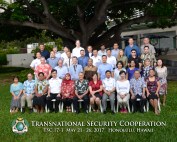
Senior regional leaders complete transnational cooperation course at DKI APCSS
Thirty-two senior leaders from twenty-nine locations and two regional organizations participated in the Transnational Security Cooperation course (TSC 17-1) from May 21-26 at the Daniel K. Inouye Asia-Pacific Center for Security Studies (DKI APCSS). The [...]
Alumni Perspectives: The Development of Japan Special Operations Command’s Capability: 21st Century Samurai Diplomats
"The Development of Japan Special Operations Command's Capability: 21st Century Samurai Diplomats” is a new Alumni Perspectives from former DKI APCSS intern Ryota Akiba. In his paper, Akiba discusses the gap in Japan’s self-defense [...]
Alumni Perspectives: Mutual Independence
U.S. Marine Corps Captain Jason Condi Alumnus U.S. Marine Corps Captain Jason Condi has written a research paper on “Mutual Independence: Countering Exclusive Nationalism Through the ASEAN Way.” This paper is now available [...]


