

Our TC Community of Interest Educates, Connects, and Empowers security practitioners to provide opportunities for regional cooperation on the challenges to economic, social, political and security matters of transnational crime. We also work to advance collaboration in security sectors, security-related processes, and decision making against the challenges of transnational crime.
The TC Community of Interest shares information through course lectures, webinars, sharing resource links, and the Take20 podcast series. You can also follow them on LinkedIn in the TC Community Group
Areas of interest include (but not limited to):
- Cybersecurity
Cybercrime and associated cyber-attacks know no borders and evolve at a rapid pace. (https://www.interpol.int/en/Crimes/Cybercrime) - Illegal, Unregulated and Unreported (IUU) Fishing
IUU Fishing has replaced piracy as the leading global maritime security threat. If IUU fishing continues unchecked, we can expect deterioration of fragile coastal states and increased tension among foreign-fishing Nations, threatening geo-political stability around the world. (ADM Shultz, COMDT USCG) - Transnational Organized Crime
Transnational organized crime involves the planning and execution of illicit business ventures by groups or networks of individuals working in more than one country. These criminal groups use systematic violence and corruption to achieve their goals. Crimes commonly include money laundering; human smuggling; cybercrime; and trafficking of humans, drugs, weapons, endangered species, body parts, or nuclear material.
Transnational crime ring activities weaken economies and financial systems and undermine democracy. These networks often prey on governments that are not powerful enough to oppose them, prospering on illegal activities, such as drug trafficking, that bring them immense profits. In carrying out illegal activities, they upset the peace and stability of nations worldwide, often using bribery, violence, or terror to achieve their goals.
The political turmoil of the 21st century and advances in technology make transnational crime a concern for the United States. Increased travel and trade and advances in telecommunications and computer technology have had the unintended effect of providing avenues for the rapid expansion of transnational organized crime activities. Policing objectives in the United States must extend beyond national borders to seek out and target this type of crime. Only through international collaboration and information exchange can the United States develop effective protocol and policies for countering these crimes and mount a serious opposition.
National Institute of Justice
Illegal Unreported Unregulated (IUU) Fishing

Security Nexus | Webinar Episode 9: Fishing for Security from Sea Slavery
By James M. Minnich The vast expanse of the Indo-Pacific conceals a dark secret: sea slavery, a human rights crisis entwined with [...]
Deconstructing RFMOs: the Politics of Protecting Fish Webinar Now Online
In this webinar, experts “dive” into the world of Regional Fisheries Management Organizations (RFMO) and the inner workings of how these bodies regulate the business of fishing. Security practitioners, policy makers, and fish enthusiasts alike will gain a better understanding of how decisions are made and the barriers to effective management.
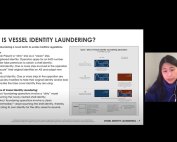
How Vessel Identity Laundering Facilitates North Korea’s Maritime Sanctions Evasion
The Center for Advanced Defense Studies (C4ADS) and the Daniel K. Inouye Asia-Pacific Center for Secuirty Studies (DKI APCSS) recently joined forces [...]

Rebalance U.S. Coast Guard Cutters to Help Advance a ‘Free and Open’ Indo-Pacific
“Rebalance U.S. Coast Guard Cutters to Help Advance a ‘Free and Open’ Indo-Pacific,” is the title of a paper by Lt. Cmdr. Mike Moyseowicz [...]
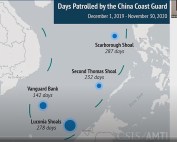
Take 20: Orbit-2-Ocean: Technology Advancing Maritime Domain Awareness
On May 4, 2021, DKI APCSS' LCDR Keith Wilkins chatted with Greg Poling and Ted Schmitt, for a webinar on “Orbit-2-Ocean: Technology [...]
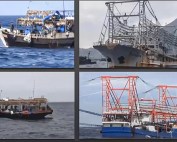
Take 20: Tracking Chinese Dark Fishing Fleets
On October 27, 2020, DKI APCSS’ Dr. Inez Miyamoto, with LCDR Keith Wilkins, chatted with Mr. Jaeyoon Park and Ms. Katherine Seto, [...]
IUU Fishing Resources
S. Government
- U.S. Coast Guard IUU Fishing Strategic Outlook
- NOAA IUU Fishing
- NOAA IUU Fishing and Seafood Fraud
- National Maritime Intelligence-Integration Office (NMIO)
- U.S. Department of Transportation Volpe Center
- Foreign Assistance
International
- Advanced Computation Laboratory
- Australia Pacific Security College
- Fisheries, Aquaculture and Marine Ecosystems (FAME)
- Indonesia Maritime Information Centre
- Pacific Islands Forum Fisheries Agency
- Pacific Islands News Association
- Pacific Islands Oceanic Fisheries Management
- Regional Maritime Information Fusion Center
- The Pacific Community
- The World Bank
- United Nations Agreement on Port State Measures
- United Nations Ocean Conference
Non-Government Organizations
- Blue Justice
- C4ADS
- Council on Foreign Relations
- Environmental Defense Fund
- Environmental Justice Foundation
- Environmental Law Institute
- Global Dialogue on Seafood Traceability
- Global Environment Facility
- Global Fishing Watch
- HawkEye360
- International MCS Network
- International Seafood Sustainability Foundation
- JSTOR
- NLA International
- OceanMind
- Organisation for Economic Co-operation and Development
- Pew Charitable Trusts
- Royal United Services Institute
- Sea Dragon
- Sea Shepherd
- SkyTruth
- Spatial Monitoring and Reporting Tool (SMART)
- Stable Seas
- Stimson
- Verumar
- Vulcan Skylight
- WildAid
- WorldFish Center
Cybersecurity

2025 DKI APCSS Alumni Awards: Recognizing Excellence in Indo-Pacific Security
The Daniel K. Inouye Asia-Pacific Center for Security Studies announces the 2025 Alumni Awards, honoring leaders in cybersecurity, NCO professionalization, and civil-military cooperation who advance Indo-Pacific security and collaboration.

Kathmandu Visit Highlights Nepal’s Strategic Role in Regional Stability
DKI APCSS recently conducted key leader engagements in Kathmandu, Nepal, highlighting the nation’s strategic role in regional stability. DKI APCSS Director Suzanne Vares-Lum joined Adm. Samuel Paparo, commander of U.S. Indo-Pacific Command, to meet with senior Nepali leaders and U.S. Embassy partners. Discussions focused on shared security priorities, including disaster preparedness, humanitarian assistance, and Nepal’s contributions to peacekeeping operations. The visit also celebrated the impactful work of DKI APCSS alumni, showcasing the program’s role in fostering education, connection, and empowerment across the Indo-Pacific region.
Take 20: International Ship and Port Facility Security (ISPS) Code and Emerging Cybersecurity Threats
DKI APCSS’ LCDR Keith Wilkins chats with International Port Security Liaison Officers (IPSLOs) from U.S. Coast Guard Activities Far East (FEACT) in Tokyo, Japan. In this video, the IPSLOs discuss the International [...]

ASEAN Takes a Bold Cybersecurity Step
Associate Professor Elina Noor has a new article entitled “ASEAN Takes a Bold Cybersecurity Step” published this week by The Diplomat. In her article Noor states that the “regional grouping looks to produce meaningful [...]
Transnational Crime
On November 2, 2020, Dr. Elizabeth Kunce of DKI-ACPSS chatted with Dr. Marika McAdam, an international law and policy adviser for the Bali Process on People Smuggling, Trafficking in Persons and Related Transnational Crime. During this podcast Dr. McAdam discussed recent regional trends in human trafficking and migrant smuggling.
Dr. Marika McAdam:
Dr. McAdam is an independent international legal consultant and adviser specialized in rights-based criminal justice responses to human trafficking, migrant smuggling and related issues. She is currently serving as international law and policy adviser for the Bali Process on People Smuggling, Trafficking in Persons and Related Transnational Crime and is on the editorial board of the Anti-Trafficking Review. Her recent research examined issues of shelter practices for victims of trafficking, human trafficking in conflict settings, and the law and ethics of human trafficking data collection.
Marika drafted key publications for the United Nations Office on Drugs and Crime, the International Organization for Migration, the Office on the High Commissioner for Human Rights and others including the NEXUS Institute and Chatham House.
And, she has written a book on Freedom from Religion and Human Rights Law. Marika has a PhD in international human rights law.
Resources referenced during the videocast:
This videocast was put together by the Daniel K. Inouye Asia Pacific Center’s Transnational Crime Community of Interest, where we connect with transnational crime experts to hear what is happening around the world.


