

By Douglas Carroll, DKI APCSS Public Affairs Specialist
HONOLULU — In mid-May, 2026, Maama Misi flew from Nuku’alofa, the capital of the Kingdom of Tonga, to Honolulu to deliver an address to the class attending the Comprehensive Security Course (CSC) 26-2. He spoke about his recently completed, historic Fellow Project—his nation’s first National Security Policy (NSP)—but only after much coaxing from his longtime friend, Alfred.
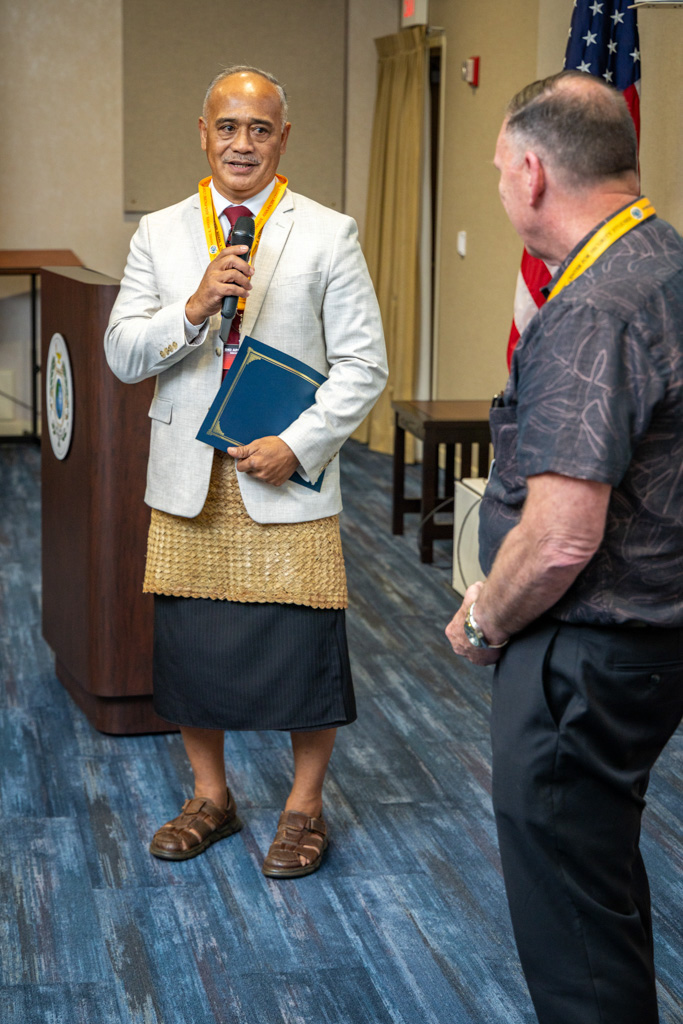 “My first time interacting with APCSS was back in 2014, in Vanuatu,” Misi said. “There was a workshop there that I attended and also where I first met Alfred.”
The event he referenced was the Regional Security Architecture in Pacific Islands 2014, held in Port Vila. There, Misi first became an alumnus of the Center, attending as then-Lt. Col. Misi, Component Commander, Land Forces of His Majesty’s Armed Forces of Tonga (HMAF).
Security practitioners from 20 locations and 10 international organizations participated in that workshop, building a shared appreciation of key regional security challenges and priorities. One of the presenters at the event was APCSS Professor Alfred Oehlers, who was one of the Center faculty supporting the workshop.
“That gave me a very good understanding and basis for looking at national security architecture,” Misi said. It also laid the groundwork for a highly fruitful professional and personal friendship.
“I first came to the Center in 2023 for another workshop, and I had already started doing my research on an NSP and on how to go about doing it,” Misi said. “This seminar was on a different agenda, but I was happy to attend because it gave me the opportunity to seek support from the Center on developing our policy. From then on, Oehlers continued to work with me and actually helped lay the foundation for this NSP, and I’m very thankful for that support.”
The impetus to create such a weighty document dates back to expectations from the Boe Declaration on Regional Security, adopted by all members of the Pacific Islands Forum in Nauru on Sept. 5, 2018. The declaration recognizes an expanded concept of security, including human, cyber, and environmental security, and frames regional responses to emerging security issues.
The Tongan government’s capacity to support such a project encouraged Misi to start identifying partners with the tools required to make it a reality, such as DKI APCSS, the Pacific Security College of Australia, and others. Aside from advisors, he also needed to create a team of Tongans to lead, compile priorities, and eventually draft the policy.
Consulting with all government ministries and aspects of Tongan society proved challenging in an archipelagic nation comprised of over 170 islands scattered over 700,000 square kilometers of the Pacific Ocean.
“The key is to be inclusive, and we had to go to all 45 inhabited islands; also, all the sectors, government, private, NGOs, even the diaspora,” Misi said. “That was the biggest effort, collection and consultation.”
Remarkably, a task that should have taken many months was completed in just one, and the final documentation was completed within half a year. It was launched by the Prime Minister, the Honorable Dr. Aisake Valu Eke, MP, in November of 2025. In the document’s foreword, he wrote: “What makes our National Security Policy unmistakably Tongan is that it has been shaped by the voices of our people. In every talanoa (talk)—with government ministries, parliament, civil society, and the broader public—one message was clear: before we look outward, we must first look within.”
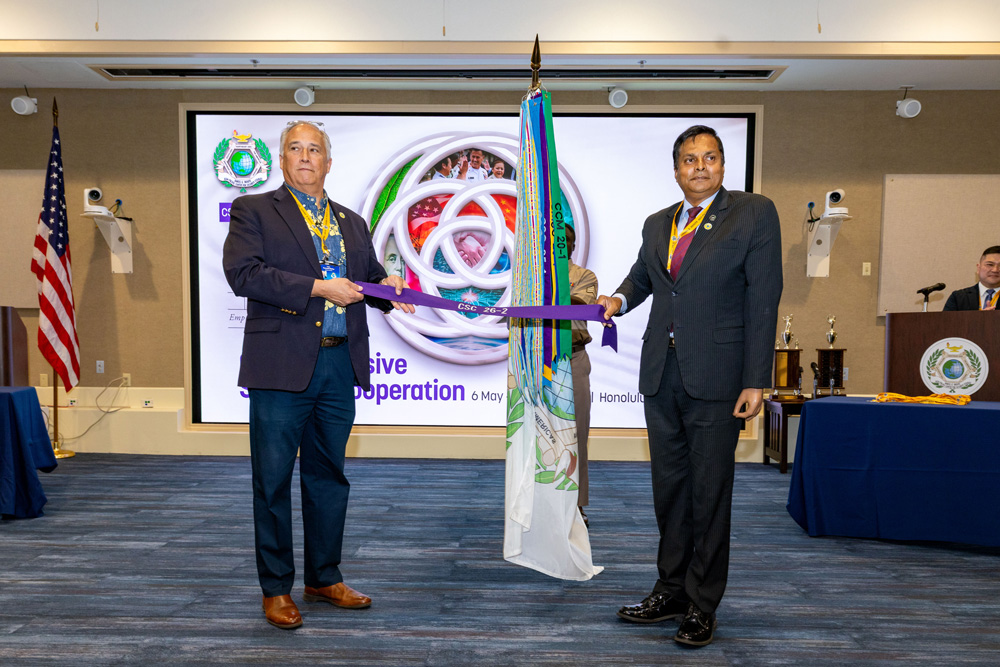
Oehlers was on hand as Misi delivered his remarks to the 140 Fellows of CSC 26-2, the largest class ever to attend DKI APCSS’ flagship course. He also took part in the ceremonial presentation of the coveted Laulima Lanyard, gifted only to those alumni who complete their Fellow Project.
“It’s a really, really proud moment for the Kingdom of Tonga, their first-ever national security policy, and it is a celebration of what is achievable if you have the right partners and the commitment,” Oehlers said. “Maama was designated as the lead for this due to his experience, his temperament, and his inclination to work with a range of inter-agency partners. A very well-qualified person to take this on.”
Regardless of their long friendship, it took a lot of persuasion from Oehlers to get Misi to board a plane and come to the Center to accept his award.
“Maama is a man whose great heart and intellect are only matched by his humility,” Oehlers added. “Yet he joins a small number who have distinguished themselves not only in their achievements and milestones, but also by the manner in which they lead.”



Leave A Comment