

Afterword
America’s Future in a Contested World
James M. Minnich
The Semiquincentennial Pivot: A Legacy of Renewal
The United States reaches its 250th year of independence not at the end of history, but at a new and formidable beginning. In 1776, a nascent republic asserted its sovereignty in a world of predatory empires and contested seas. In 2026, a historical symmetry emerges: the era of uncontested American primacy has passed,[ii] giving way to an increasingly competitive multipolar order that demands the same strategic agility and moral fortitude required at the nation’s founding.
This assessment is increasingly shared beyond academic and defense circles.[iii] Senior U.S. leaders now openly acknowledge that the post-Cold War period of uncontested dominance has ended, describing the present moment as a “new and very dangerous era” defined by renewed great-power rivalry.[iv]
In a 2026 address at the World Economic Forum, Canadian Prime Minister Mark Carney described the moment not as a transition to a new order, but as a rupture—one in which rules no longer reliably constrain power and economic interdependence can be weaponized. His warning was not alarmist, but practical: when stabilizing expectations erode faster than institutions can adapt, the risk of crisis escalation rises even in the absence of deliberate intent.[v]
Competitor perspectives point to a similar structural diagnosis. Writing from a Russian strategic vantage point, Sergey Karaganov and Dmitry Suslov argue that since roughly 2017–2018, inherited international orders have entered a period of sustained erosion, with any successor order likely to take decades to consolidate.[vi] Economic historian Adam Tooze cautions against assuming that such periods necessarily culminate in a clearly defined “next order,” noting that the historical record offers few clear precedents for orderly transitions between system-shaping powers.[vii]
The practical implication is straightforward: when shared expectations of restraint lag behind intensifying competition, escalation risk rises—even in the absence of deliberate intent. In such conditions, deterrence failure is more likely to be sudden than gradual, with little time for correction once escalation begins. For the United States, navigating this transition requires more than reactive adjustment; it demands structural reinvestment in—and tighter integration of—the instruments of national power.
The next 250 years will not be secured by the momentum of the last. History grants no permanent status to any power, and assuming that the international order will remain stable by default is a dangerous fallacy. Today’s strategic environment is arguably the most demanding since the early Cold War, defined by unevenly distributed power, colliding ambitions, and a narrowing margin for strategic error.[viii] The central question of this milestone year is whether American institutions, alliances, and the national character can adapt with sufficient speed to deter a catastrophic global conflict.
The Department of War’s Acquisition Transformation Strategy reflects this same historical logic. It frames today’s challenges not as a matter of strategic vision but of execution, prioritizing workforce recapitalization, “speed over process,” and “digital first operations” to rebuild military capacity, revive the warrior ethos, and restore deterrence credibility in a rapidly changing threat environment.[ix]
Can Deterrence Hold in a Competitive Multipolar Order?
Answering whether deterrence can hold in a competitive multipolar order requires clarity about the relationship between strategy, force, and the profession of arms. In a contested century, deterrence, lethality, and warrior ethos are not separate lines of effort but a singular, reinforcing logic of power.
Scholars of great-power politics have long warned that balanced multipolar systems are inherently less stable than bipolar ones—a dynamic already evident in regions such as Northeast Asia, where multiple nuclear-armed great powers interact without a single, uncontested hegemon.[x] In such environments, deterrence establishes the strategic condition by shaping adversary behavior; lethality provides the means to impose decisive costs at scale and over time; warrior ethos governs the human application of force, ensuring that power is employed with discipline, judgment, and moral clarity. Lethality without ethos risks excess and strategic instability; ethos without lethality invites coercion; deterrence without both lacks credibility. Together, they form a durable foundation for security leadership—one that rests not only on advanced capabilities, but on the capacity to fight, sustain, adapt, and prevail while preserving legitimacy in the eyes of allies, partners, and the American people.
Deterrence in a competitive multipolar system is therefore structurally more fragile than in a bipolar one.[xi] Unlike the Cold War, today’s strategic environment lacks a single, universally understood equilibrium. Multiple capable actors operate across overlapping regions, domains, and thresholds, often pursuing asymmetric advantages rather than direct confrontation. Gray-zone activity, coercive signaling, cyber operations, space competition, and economic leverage now coexist with traditional military postures, compressing decision timelines and complicating escalation management and crisis stability. This fragility is compounded by institutional latency: recent oversight findings show that the expected time to deliver initial capability for major defense acquisition programs averages approximately 12 years, a timeline that is increasingly incompatible with modern competitive dynamics.[xii]
The greatest danger in such an environment is not deliberate escalation, but miscalculation born of interaction.[xiii] In systems defined by compressed decision timelines and overlapping thresholds, deterrence can fail not through intent but through rapid action–reaction dynamics that outpace judgment and control. Failure will not unfold gradually; it will arrive suddenly, leaving little opportunity for correction once escalation begins.
Deterrence, therefore, can no longer rely solely on declaratory policy or the existence of superior platforms. Credibility rests on demonstrated capacity, visible readiness, and the ability to absorb shocks while sustaining combat power under pressure.
The ability to replace losses, surge production, protect logistics, and maintain command and control in contested environments is as central to deterrence as forward presence or alliance commitments. The industrial test is already visible in munitions. The Army is currently producing roughly 40,000 155mm rounds per month, with the 100,000-per-month objective now projected for mid-2026, underscoring how surge capacity, timelines, and supply chains directly shape deterrence credibility in practice.[xiv]
Equally important is strategic clarity. Ambiguity can create space for maneuver, but persistent ambiguity about interests, thresholds, or resolve invites miscalculation.[xv] In a crowded strategic environment, adversaries will probe seams—between domains, between allies, and between policy and capability.[xvi] Deterrence holds when those seams are minimized and when responses are sufficiently predictable to shape behavior, without becoming so rigid that they foreclose adaptation.
Strategic Implications: What Partners Must Do
The future of American security leadership will be decided not only in Washington but across allied capitals. The United States remains the system’s central stabilizing force, but it cannot, and should not, carry the burden alone. Effective deterrence in the Indo-Pacific, Europe, and beyond depends on capable, resilient partners who are aligned in purpose.
This does not require uniformity; it requires complementarity.
Partners strengthen deterrence by investing in capabilities that complicate adversary planning, expand operational depth, and reinforce collective endurance. That includes resilient basing, access and sustainment agreements, interoperable command and control, and defense-industrial capacity that can surge in crisis. It also includes political resolve—the willingness to make tough choices about defense spending, force posture, and risk acceptance before a crisis, rather than during one.
Equally critical is alignment in strategic outlook. Allies need not share identical threat perceptions, but they must share a common understanding of behaviors that cannot be normalized and actions that demand collective response. Fragmentation—whether political, industrial, or doctrinal—creates openings for coercion. Cohesion closes them.
For many partners, this will require moving beyond symbolic contributions to operational roles. For others, it will mean modernizing forces, reforming acquisition systems, or addressing domestic constraints that limit readiness. For all, it means recognizing that security cooperation is no longer a peacetime activity separate from warfighting preparation; it is a core element of deterrence itself.
Strategic Execution in a Competitive Era
The strategic challenge of the next 250 years is not one of intent, but of execution. American strategy is strongest when ends, ways, and means are aligned, and weakest when aspirations outpace capacity. In a competitive multipolar environment, execution is no longer a bureaucratic concern but a strategic variable, as delays measured in years collide with crises measured in days.
Strategic coherence depends on disciplined tradeoffs, alignments of resources with stated objectives, and restraint in pursuing ambitions that exceed sustainable capacity. It also requires modernization of the institutions that underpin national power—warfighting acquisition, personnel systems, industrial policy, and interagency coordination—so they can operate on competitive timelines rather than peacetime cycles. Deterrence falters not because strategies are flawed on paper, but because institutions cannot execute them at speed or scale. The magnitude of the execution challenge is considerable: GAO reports the Department plans to invest nearly $2.4 trillion across 106 major weapon programs—making acquisition performance a strategic variable rather than an administrative detail, and a direct contributor to deterrence credibility.[xvii]
Time has also emerged as a defining strategic factor. In recent conflicts and crises, escalation decisions have increasingly unfolded over days or even hours rather than months, placing a premium on institutions that can sense, decide, and act faster than their competitors. Delays in procurement, indecision over force posture, or hesitation in signaling resolve can produce cascading effects in a competitive environment. Speed—of decision, adaptation, and response—has become a form of advantage. The strategy’s approach is already being operationalized. A January 2026 framework agreement, reinforced by subsequent contract actions to accelerate PAC-3 MSE production, aims to expand annual outputs from roughly 600 toward 2,000 interceptors—illustrating how longer-horizon demand signals can translate into industrial investment, reduced lead times, and greater magazine depth.[xviii]
Sustained security leadership ultimately rests on public trust, a clear articulation of national interests, and a shared understanding that preparedness is not provocation; it is prevention.
The Profession of Arms and the Future of American Military Power
For warfighters, the challenge ahead is both familiar and unprecedented. The fundamentals of warfare—discipline, cohesion, leadership, and moral clarity—remain unchanged. What has changed is the pace, complexity, and transparency of conflict.
Future warfighters must be prepared to operate across domains, under constant observation, and amid contested information environments. They must integrate new technologies without surrendering judgment, maintain ethical standards under pressure, and lead formations that are increasingly joint, combined, and distributed.
The warrior ethos remains central, not as a nostalgic relic, but as a source of resilience and legitimacy. It is the discipline and legitimacy that distinguish a profession of arms from force applied without restraint or purpose. In prolonged competition, character is a strategic asset. Units that can endure uncertainty, adapt under stress, and maintain discipline in ambiguous situations are not merely tactically effective; they are strategically stabilizing.
Education, training, and leader development must therefore emphasize adaptability, strategic literacy, and accountability. Tactical excellence alone is insufficient in an era where junior decisions can have strategic consequences.
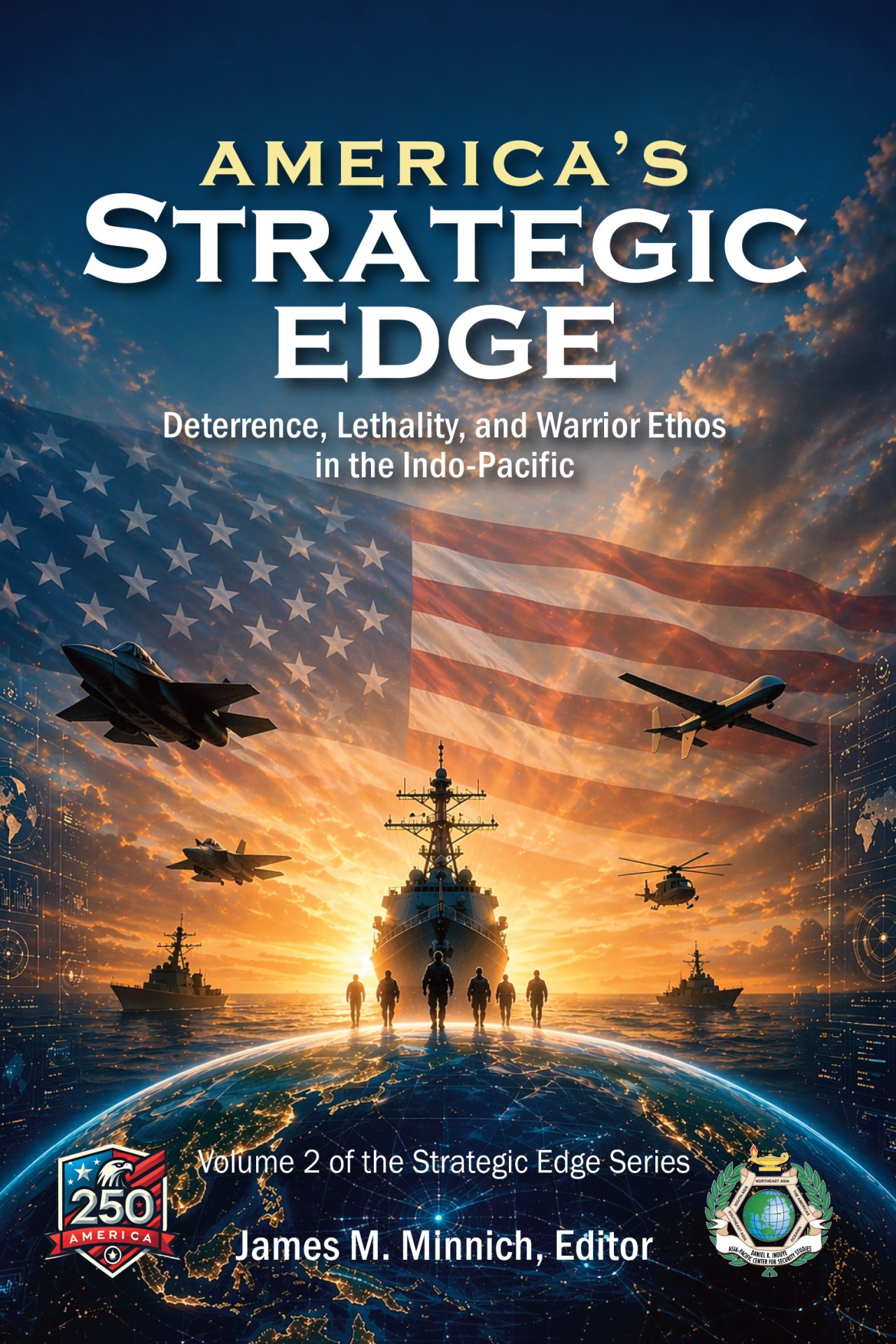
If the first volume described the environment of disruption, division, and competition, this volume explains how the United States preserves its advantage within it. The next volume will examine the industrial, alliance, and institutional foundations that enable sustained advantage.
Preserving the Edge
America’s advantage has never rested solely on material power. It has rested on the ability to organize that power—through alliances, institutions, and leadership—toward a clear and purposeful goal. That remains true today.
The next 250 years will test whether the United States can preserve that edge in a world where advantage must be renewed, not assumed. Success will not be defined by permanent superiority or universal compliance. It will look like sustained deterrence, managed competition, and the prevention of catastrophic war.
This is not a call for complacency or for confrontation. It is a call for seriousness—about the environment we face, the limits of our power, and the responsibilities that come with leadership.
The future will not be secured by assuming the past will repeat itself. It will be secured by leaders, policymakers, and warfighters who understand that advantage must be earned, renewed, and defended—again and again—if the United States is to remain the world’s leading security force in a contested century.
Endnotes
[i] The author is solely responsible for the views expressed in this publication, which do not necessarily represent the official policy or position of the Daniel K. Inouye Asia-Pacific Center for Security Studies, the U.S. Department of War, or the U.S. government.
[ii] U.S. Department of Defense, Summary of the 2018 National Defense Strategy of the United States of America (Washington, DC: DOD, 2018), 3, https://media.defense.gov/2020/May/18/2002302061/-1/-1/1/2018-NATIONAL-DEFENSE-STRATEGY-SUMMARY.PDF.
[iii] Christopher Preble, “A Credible Grand Strategy: The Urgent Need to Set Priorities,” Stimson Center, January 25, 2024, https://www.stimson.org/2024/a-credible-grand-strategy-the-urgent-need-to-set-priorities/.
[iv] J. D. Vance, “Commencement Address at the United States Naval Academy” (Annapolis, MD, May 23, 2025), transcript, American Rhetoric, https://www.americanrhetoric.com/speeches/jdvanceusnavalacademycommencement.htm
[v] Mark Carney, “Special Address,” World Economic Forum Annual Meeting, Davos, January 20, 2026, transcript, World Economic Forum, https://www.weforum.org/stories/2026/01/davos-2026-special-address-by-mark-carney-prime-minister-of-canada/.
[vi] Sergey A. Karaganov and Dmitry Suslov, “A New World Order: A View from Russia,” in Multipolarity: The Promise of Disharmony, ed. Peter W. Schulze, (Frankfurt am Main: Campus Verlag, 2018), 59–82; Sergey A. Karaganov and Dmitry Suslov, “A New World Order: A View from Russia,” Russia in Global Affairs, May 19, 2018, https://eng.globalaffairs.ru/articles/a-new-world-order-a-view-from-russia.
[vii] Adam Tooze, interview by Ezra Klein, “How the World Sees America,” The Ezra Klein Show, podcast audio, January 30, 2026, New York Times Audio, https://www.nytimes.com/2026/01/30/opinion/ezra-klein-podcast-adam-tooze.htm.
[viii] Preble, “A Credible Grand Strategy.”
[ix] U.S. Department of War, Office of the Under Secretary of War for Acquisition & Sustainment, Acquisition Transformation Strategy (Washington, DC: Department of War, November 10, 2025), 3, https://media.defense.gov/2025/Nov/10/2003819441/-1/-1/1/ACQUISITION-TRANSFORMATION-STRATEGY.PDF.
[x] John J. Mearsheimer, The Tragedy of Great Power Politics (New York: W.W. Norton, 2003), 381; Kenneth N. Waltz, Theory of International Politics (Reading, MA: Addison-Wesley, 1979), 168–72.
[xi] Waltz, Theory of International Politics, 170–72.
[xii] U.S. Government Accountability Office, Weapon Systems Testing: DOD Needs to Update Policies to Better Support Modernization Efforts, GAO-26-107009 (Washington, DC: GAO, December 11, 2025), 1, https://www.gao.gov/assets/gao-26-107009.pdf; U.S. GAO, Defense Acquisition Reform: Persistent Challenges Require New Iterative Approaches to Delivering Capability with Speed, GAO-25-108528 (Washington, DC: GAO, June 11, 2025), https://www.gao.gov/products/gao-25-108528.
[xiii] Waltz, Theory of International Politics, 172.
[xiv] Josh Luckenbaugh, “Army Falls Short of 155mm Production Goal,” National Defense, August 14, 2025, https://www.nationaldefensemagazine.org/articles/2025/8/14/army-falls-short-of-155mm-production-goal.
[xv] Richard Haass and David Sacks, “American Support for Taiwan Must Be Unambiguous,” Foreign Affairs, September 2, 2020, https://www.foreignaffairs.com/print-article/node/1126429; Thomas C. Shelling, “The Strategy of Conflict Prospectus for a Reorientation of Game Theory,” Journal of Conflict Resolution 2, no 3. (1958), 203–10.
[xvi] Shelling, “The Strategy of Conflict,” 222–25.
[xvii] U.S. GAO, Defense Acquisition Reform, GAO-25-108528, 1.
[xviii] U.S. Department of War, “Department of War Establishes New Acquisition Model to More than Triple PAC-3 MSE Production in Partnership With Lockheed Martin,” press release, January 6, 2026, https://www.war.gov/News/Releases/Release/Article/4371320/department-of-war-establishes-new-acquisition-model-to-more-than-triple-pac-3-m/; Darrell Ames, “U.S. Army Advances Accelerated PAC-3 MSE Production Through Contract Action,” April 10, 2026, https://www.army.mil/article/291670/u_s_army_advances_accelerated_pac_3_mse_production_through_contract_action.


