

Fellow Project is an integral part of DKI APCSS’s long courses. It requires participants to undertake a project demonstrating their expertise by applying their acquired knowledge and skills. This process includes:
- Collaboration and Networking: Fellows work together and engage with faculty and experts, fostering relationships and mutual understanding.
- Perspective Sharing: Discussing local, national, and regional security challenges enhances networks and deepens understanding of a rules-based order and a free and open Indo-Pacific region.
- Research and Analysis: Fellows leverage their experience to research a specific topic, increasing situational awareness, creating viable options, and forming practical recommendations through critical thinking.
- Expand capacity for critical thinking
- Practice querying, dialogue, cooperation, and connecting with key stakeholders
- Hone inquiry skills for future work
- Produce outcomes of real-world value
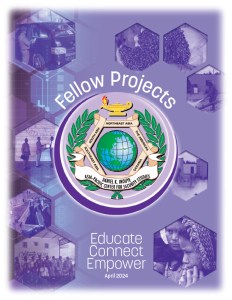
Read the latest fellow’s project booklet to celebrate their achievements and discover how their work fosters a secure and prosperous region.
- Individual Fellow Project: Each fellow undertakes a project focusing on a specific challenge related to a policy, program, process, or practice. This project is completed independently, allowing the fellow to apply their unique insights and expertise.
- Cohort Project (Group Project): In this format, fellows collaborate on a group project. To participate in a Cohort Project, each fellow must be preselected by their respective country’s embassy and DKI APCSS. This collaborative approach encourages teamwork and leverages the diverse perspectives of the fellows involved.
* If your country wishes to send a team to work on a Cohort Project, inform the US Embassy, the DKI APCSS Recruiter (recruiter@apcss.org), and the Fellow Project Team (fellowsproject@dkiapcss.net).
Fellow Project Highlight
Project Phases
| Fellows Project | Cohort Projects | |
|---|---|---|
| Before Course |
|
|
| During Course |
|
|
| After Course |
|
|
Latest News and Guest Speakers
Singapore Chief of Defense Visits APCSS
Lt. Gen. Chee Meng Ng (SE07-1), SN Air Force Chief of Defense Force, Ministry of Defense. Singapore, visited the Asia-Pacific Center for Security Studies today for an orientation and exchange of ideas with APCSS leadership [...]
PACAF Commander visits APCSS
Gen. Lori J. Robinson (far right) and her staff discuss AP issues with APCSS Staff. Gen. Lori J. Robinson, Commander, Pacific Air Forces; Air Component Commander for U.S. Pacific Command; and Executive Director, [...]
Alumni Perspectives: Empowering Indonesia’s Local Seafarers to Contain Smuggling
Mr. Kris Mada participates in a discussion while attending ASC 14-3. While attending APCSS courses, Fellows are required to complete a Fellows Project which may be done as a presentation, research paper or [...]
109 Fellows Complete Advanced Security Cooperation Course 14-3
(HONOLULU) – Security practitioners from 34 nations and territories graduated from the Advanced Security Cooperation Course 14-3 today at the Asia-Pacific Center for Security Studies. One hundred nine military and civilian Fellows attended the nearly [...]
New Occasional Paper on Water Security
Water is the topic of the latest Occasional Paper published by the Asia-Pacific Center for Security Studies. “State Water Resource Competition and the Resulting Consequences of Diminished Water Supply” by Mitchell L. Gildea looks at [...]
Alumni Perspective: A Relationship of Convenience: The Russo-Chinese Strategic Partnership
The APCSS Regional Security Studies Internship Program brings to the Center graduate and undergraduate students from around the world to assist and participate in APCSS courses. Amanda Lamothe-Cadet served as a Regional Security Studies Intern [...]


